

Wire EDM vs. Traditional Machining: Which Process Delivers Better Precision?
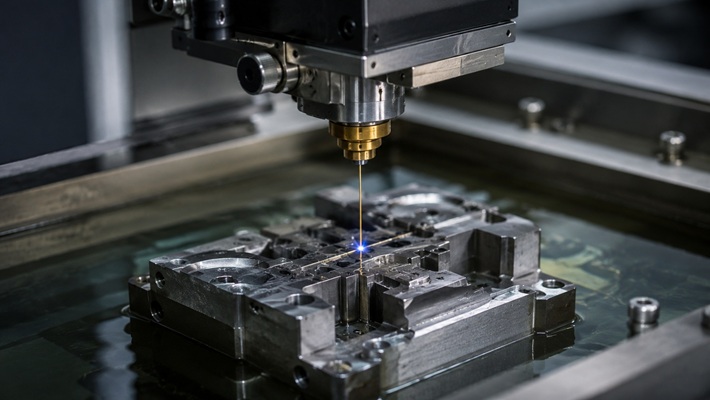
Wire EDM cuts with electrical sparks and never touches the workpiece, so it holds tighter tolerances and handles hardened metals without tool wear. Traditional machining (milling, turning, drilling) cuts faster with physical tools, making it better for bulk material removal and high-volume runs. Choose wire EDM for hardened steel, complex profiles, and tight tolerances. Choose traditional machining for speed, soft materials, and simple shapes.
Introduction
A tool room manager picks the wrong process once, and the cost shows up everywhere: scrapped blanks, a cracked end mill, a die that’s 0.02 mm out of spec and won’t seat right. Wire EDM and traditional machining solve different problems, and confusing the two is one of the most common (and expensive) mistakes in precision manufacturing.
Wire EDM uses a thin, electrically charged wire to erode material through controlled sparks. Traditional machining, like milling and turning, uses a physical cutting tool that pushes through the metal. Neither process is “better” across the board. The right choice depends on your material, your tolerance, and how many parts you’re making.
This guide breaks down exactly how each process works, where each one wins, and how to decide which fits your next job.
What Is Wire EDM?
Wire EDM (Electrical Discharge Machining) cuts conductive metal using a thin brass or zinc-coated wire that never physically touches the workpiece. Instead, it fires thousands of electrical sparks per second through a dielectric fluid, eroding material along the exact path your CAD file specifies.
How Wire EDM Works
The wire acts as one electrode and the workpiece acts as the other. A small gap separates them, filled with deionized water that acts as the dielectric fluid. When voltage is applied, a spark jumps across that gap and vaporizes a tiny bit of metal.
Here’s what makes this different from cutting with a blade or a drill bit:
- No physical contact. The wire never pushes against the part, so there’s no cutting force and no clamping distortion.
- Continuous wire feed. The wire constantly spools through the machine, so the same worn section never cuts twice.
- CNC-guided path. Multi-axis movement (X, Y, Z, and often U, V) lets the wire cut tapers, sharp corners, and complex 2D and 3D profiles in one setup.
Because there’s no mechanical force involved, wire EDM doesn’t care how hard the material is. It cares whether the material conducts electricity.
Materials Suitable for Wire EDM
Wire EDM works on any conductive metal, regardless of hardness:
- Hardened tool steel
- Carbide
- Titanium
- Inconel and other high-temperature alloys
- Stainless steel
- Copper and graphite (used for mold and die components)
This is one of the biggest practical advantages over conventional cutting tools, which lose their edge fast on hardened or exotic alloys.
What Is Traditional Machining?
Traditional machining is the umbrella term for processes that remove material using a physical cutting tool: milling, turning, drilling, and grinding. These methods have been the backbone of manufacturing for over a century, and for good reason. They’re fast, flexible, and well understood on almost every shop floor.
Common Conventional Machining Processes
- Milling: A rotating cutter removes material from a stationary or moving workpiece. Used for flat surfaces, slots, pockets, and contoured shapes.
- Turning: The workpiece rotates while a stationary tool removes material, typically on a lathe. Best for cylindrical parts like shafts and bushings.
- Drilling: A rotating bit creates round holes at a fixed diameter.
- Grinding: An abrasive wheel removes small amounts of material, usually for final surface finish.
How Material Removal Occurs
All four processes rely on direct mechanical contact. A hardened cutting edge pushes into the workpiece, shears off a chip, and the chip is carried away by coolant or air. This works well for most metals, but it has two built-in limits:
- The tool has to be harder than the material it’s cutting.
- Cutting forces apply stress to the part, which can cause distortion in thin-walled or delicate components.
These limits matter most when you’re working with hardened steel, titanium, or any material that’s tough on cutting edges.
Wire EDM vs. Traditional Machining: Key Differences
Cutting Mechanism
Wire EDM removes material through spark erosion, with zero physical contact. Traditional machining removes material through mechanical cutting, where a hardened tool physically shears the workpiece. This single difference explains almost every other contrast between the two processes.
Accuracy and Tolerances
How accurate is wire EDM compared to traditional machining? Wire EDM typically holds tolerances between ±0.002 mm and ±0.01 mm under normal production conditions, and high-precision setups can tighten that further depending on material, thickness, and the number of cutting passes used. Engineers select wire EDM for parts requiring high accuracy and intricate details with smooth, uniform surface finishes. Traditional machining typically holds moderate to high tolerances, often in the range of ±0.01 mm to ±0.1 mm depending on the machine, tooling, and operator skill, which is excellent for most parts but rarely matches wire EDM on the tightest specs.
The exact number you’ll get depends heavily on your material and setup. As Berlin Machineries’ own breakdown of EDM wire cutting tolerance explains, marketing claims of universal “micron accuracy” don’t hold up across every job. Servo quality, filtration, and multi-cut strategy all affect the final number more than the spec sheet alone.
Surface Finish Quality
Wire EDM produces a clean, consistent surface finish straight off the machine, since there’s no cutting force to raise burrs or tear material at the edges. Traditional machining can deliver a good finish too, but rough milling or turning often leaves burrs that need a deburring or polishing step before the part is ready to use.
If your part needs to go straight from the machine to assembly with no secondary finishing, that difference matters a lot on a production schedule.
Material Hardness Capability
This is where wire EDM has a clear structural advantage. Because cutting happens through electrical erosion, hardness simply isn’t a factor. A block of hardened tool steel at 60 HRC cuts the same way as a soft block of aluminum, just slower.
Traditional machining tools, on the other hand, lose their edge faster as material hardness increases. Tool wear increases the cost of machining and machine downtime, and high cutting temperatures at the tool edge during high-speed work make this worse on tougher alloys. For hardened steel and exotic alloys, this usually means slower feed rates, more tool changes, and tighter process control just to protect the cutting edge.
Tool Wear
Traditional cutting tools wear down with every part they cut, especially on abrasive or hardened materials. Machining hard materials increases tool wear and replacement costs, and complex parts often need more experienced machinists to manage that wear without sacrificing precision. Replacing end mills, inserts, and drill bits is a routine, ongoing cost in any machine shop running hard materials.
Wire EDM sidesteps this almost entirely. The wire is consumed and replaced as it spools through the machine, but it’s a low-cost consumable, not a precision-ground tool that needs regrinding or replacement mid-job.
Cutting Speed
Traditional machining wins on raw speed. A milling cutter removes far more material per minute than a wire EDM machine can erode through sparks. If you’re roughing out a large block of aluminum, milling is the practical choice every time.
Wire EDM trades speed for accuracy. It’s not built to remove a lot of material fast; it’s built to leave a finished edge exactly where the CAD file says it should be, even in materials that would chew up a cutting tool.
Part Complexity
Wire EDM handles intricate profiles, sharp internal corners, and thin walls that traditional tools physically can’t reach. A milling cutter is round, so it can never cut a perfectly sharp internal corner; the wire, by contrast, can follow almost any 2D contour your design calls for.
This is why wire EDM is the standard choice for die sets, punch profiles, and mold inserts with complex internal geometry.
Production Cost
Looking at production cost in isolation can be misleading. Traditional machining usually has a lower per-part cost on simple, high-volume jobs. But factor in tool wear, scrap from tolerance drift, and secondary deburring operations, and the gap narrows fast, especially on hardened materials.
Wire EDM often has a higher hourly machine rate, but it can reduce total cost per finished part by cutting out rework and secondary finishing on tight-tolerance components.
Comparison Table: Wire EDM vs Conventional Machining
Factor | Wire EDM | Traditional Machining |
Cutting Method | Electrical discharge | Mechanical cutting |
Accuracy | Extremely high | Moderate to high |
Tool Contact | No | Yes |
Tool Wear | Minimal | High |
Surface Finish | Excellent | Good |
Hard Material Machining | Excellent | Challenging |
Complex Shapes | Excellent | Limited |
Burr Formation | Very low | Common |
Production Speed | Slower | Faster |
Secondary Operations | Minimal | Often required |
When Should You Choose Wire EDM?
Wire EDM makes the most sense when accuracy and material hardness matter more than raw speed. Typical applications include:
- Injection mold inserts and cavities
- Punches and stamping dies
- Aerospace components like turbine seal rings
- Medical instruments and surgical components
- Precision tooling and jig components
- Automotive mold and die work
- Hardened steel parts that would destroy a conventional cutting tool
If your part has a tolerance call-out under ±0.02 mm, or it’s made from hardened tool steel, wire EDM is almost always worth evaluating before you commit to conventional machining.
When Is Traditional Machining a Better Choice?
Traditional machining still does some things better than wire EDM ever will:
- Large material removal. Milling and turning clear bulk stock far faster than spark erosion ever could.
- High-volume production. When you’re running thousands of identical, moderate-tolerance parts, cutting speed matters more than ultra-tight accuracy.
- Simple geometries. A round shaft or a flat plate doesn’t need wire EDM’s complex-profile advantage.
- Soft materials. Aluminum, brass, and mild steel machine quickly and don’t punish a cutting tool the way hardened steel does.
- Lower tolerance requirements. If ±0.05 mm or looser is acceptable, conventional machining gets there faster and usually cheaper.
- Faster production cycles. When turnaround time drives the decision more than micron-level accuracy, traditional machining wins.
Industries That Benefit Most from Wire EDM
Tool and Die Industry
Tool rooms rely on wire EDM to cut punch and die profiles that need to seat together with almost no clearance gap. Sharp internal corners, which are nearly impossible with a round milling cutter, come naturally to wire EDM.
Aerospace Manufacturing
Aerospace parts often combine tight tolerances with exotic, hard-to-cut alloys like titanium and Inconel. Wire EDM handles both demands at once, without the tool wear that would slow down conventional machining on the same materials.
Medical Device Manufacturing
Surgical instruments and implant components need extremely consistent dimensions and a clean, burr-free edge straight off the machine. Wire EDM delivers both without an extra polishing step.
Automotive Industry
Automotive mold and die work for stamped body panels and injection-molded interior parts depends on wire EDM for the fine detail and tight fit that keeps tooling running for years without rework.
Precision Engineering
R&D shops and precision component manufacturers use wire EDM whenever a new design calls for a feature that a standard end mill physically can’t reach.
Cost Considerations: Is Wire EDM Worth the Investment?
Does wire EDM actually save money, or is it just more expensive per hour? Wire EDM often costs more per machine hour than milling or turning, but it can lower the total cost per finished part on tight-tolerance or hardened-material jobs by cutting scrap, rework, and secondary finishing out of the process.
The real comparison isn’t hourly rate against hourly rate. It’s total cost per usable part, including:
- Reduced scrap rates. Parts that come off the wire EDM machine within tolerance the first time don’t need to be remade.
- Lower rework costs. Since there’s no cutting force to distort thin or delicate features, fewer parts come out warped or out of spec.
- Improved dimensional accuracy. Tighter, more consistent tolerances mean fewer fit-up problems during assembly.
- Less tool replacement. A standard end mill or drill might only add a modest amount to a job in soft materials, but harder materials wear tools out much faster, which can add hundreds of dollars in replacement costs per project. Wire EDM avoids most of this cost entirely.
- Better part consistency. Every cut follows the same CAD path with the same wire diameter, so part-to-part variation stays low across a production run.
- Lower finishing costs. A cleaner surface finish off the machine means less time spent on deburring or polishing before the part ships.
For a one-off prototype in mild steel, traditional machining will almost always be cheaper. For a production run of hardened die components, wire EDM frequently wins on total cost once you account for scrap and rework.
Expert Insights: Questions to Ask Before Choosing a Machining Process
Before committing to either process, work through these questions with your engineering team:
- What tolerance is required? Tight tolerances under ±0.02 mm usually point toward wire EDM.
- Is the material hardened? Hardened steel and exotic alloys favor wire EDM, since hardness doesn’t slow it down.
- Does the part have complex geometry? Sharp internal corners and intricate profiles favor wire EDM over a round cutting tool.
- Is surface finish critical? If the part needs to be assembly-ready straight off the machine, wire EDM reduces secondary finishing.
- What is the production quantity? High-volume, moderate-tolerance runs often favor traditional machining on speed alone.
- Is speed more important than accuracy? If the schedule is tight and tolerances are forgiving, traditional machining gets parts out the door faster.
Conclusion
Wire EDM and traditional machining aren’t competitors so much as two specialized tools in the same toolbox. Traditional machining clears material fast and keeps high-volume production moving. Wire EDM steps in when hardness, tight tolerance, or complex geometry would push a conventional cutting tool past its limits.
The right call usually comes down to three questions: how tight is the tolerance, how hard is the material, and how many parts are you making. Get honest answers to those three, and the right process picks itself.
If you’re weighing a hardened-material job or a tight-tolerance die component, take a closer look at the CNC wire cut EDM machine range built for exactly this kind of work, and talk to a process engineer before locking in your production plan.
Frequently Asked Questions
Is wire EDM more accurate than traditional machining?
In most cases, yes. Wire EDM typically holds tighter tolerances than conventional milling or turning, often in the ±0.002 mm to ±0.01 mm range under controlled conditions, because there’s no cutting force to push the part off dimension. Traditional machining can still hit excellent tolerances, but it generally takes more setup care to match wire EDM’s consistency on hardened materials.
Can wire EDM machine hardened steel?
Yes, and this is one of its biggest strengths. Wire EDM cuts through electrical erosion rather than mechanical force, so the hardness of the material doesn’t wear down a cutting edge the way it would with a milling cutter or drill bit. Cutting speed slows on harder materials, but accuracy stays consistent.
Is wire EDM slower than CNC machining?
Generally, yes. Conventional CNC milling and turning remove bulk material much faster than wire EDM can erode it with sparks. Wire EDM is the better choice when accuracy and material hardness matter more than raw cutting speed.
Which process provides a better surface finish?
Wire EDM typically delivers a cleaner finish right off the machine, with minimal burr formation since there’s no physical tool pressing into the part. Traditional machining can also produce a good finish, but rough cuts often need a deburring or polishing step afterward.
Can wire EDM cut non-conductive materials?
No. Wire EDM relies on electrical discharge between the wire and the workpiece, so the material has to conduct electricity. Non-conductive materials like most plastics and ceramics need a different process, such as milling, laser cutting, or waterjet cutting.
Is wire EDM suitable for high-volume production?
It can be, but it’s not usually the first choice for very high-volume, simple-geometry parts where speed matters most. Wire EDM tends to deliver the best return on tight-tolerance or hardened-material components, including production runs of dies, molds, and precision tooling where rework costs would otherwise add up fast.
