

Wire EDM Machine Maintenance Checklist: Daily, Weekly, Monthly and Annual Tasks
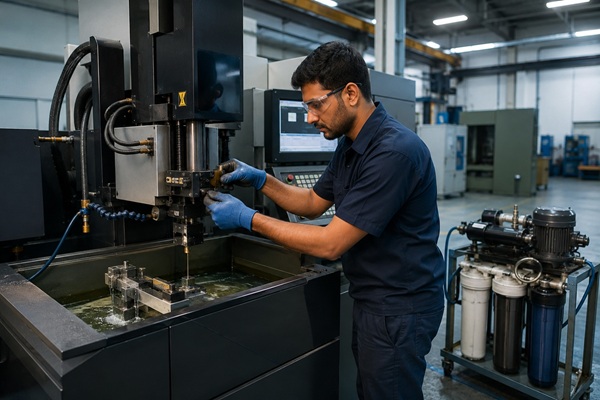
| A wire EDM machine will stop working when not properly maintained. Unlike other CNC machines that degrade slowly, a wire erosion machine fails fast when any single system is neglected. This checklist covers every key task from daily checks to annual deep service, covering the dielectric system, wire transport, guides, power contacts, and alignment. Use it to protect machine investment and prevent costly unplanned downtime. |
It’s Monday morning. You walk into the shop and the wire cut EDM machine is sitting idle. Wire has broken mid-cut. The job is scrap. The delivery is at risk. This isn’t a machine failure. It’s a maintenance failure. A wire EDM machine (also called a wire erosion machine or wire cutting CNC machine) is one of the most maintenance-intensive pieces of equipment on any shop floor. That’s not a flaw in the technology.
It’s the nature of a process that depends on precise electrical discharge, controlled fluid chemistry, and tight mechanical tolerances working together, simultaneously, on every cut. The problem is this: most shops don’t have a written maintenance schedule. Operators rely on experience.
Tasks get skipped when production pressure builds. And then something fails. This guide gives you a clear, practical wire EDM maintenance checklist organized by frequency. Daily. Weekly. Monthly. Annual. It covers every major system. It explains why each task matters. And it’s written so any operator on your floor can follow it, not just the most experienced one.
Why Wire EDM Machine Maintenance Is Non-Negotiable
A wire EDM machine is different from most CNC equipment. Industry experts point out that a milling machine will keep cutting even with a dull tool, but a wire erosion machine will not function at all when not properly maintained. The failure modes are abrupt, not gradual. Dirty wire guides cause wire breaks.
Contaminated dielectric fluid causes sparks to discharge in the wrong place. Worn power contacts slow machining speed. Clogged filters degrade surface finish. Each neglected task creates a cascade that can stop production within hours. The stakes are real. Research into EDM downtime causes shows that dielectric contamination alone is responsible for nearly 47% of unexpected machine stoppages. That’s not a small number.
It means almost half of all unplanned downtime in a wire EDM shop is preventable with a simple fluid maintenance routine. For tool rooms, mold manufacturers, and precision engineering units, this matters even more. You’re working to tolerances of 0.015 mm to 0.020 mm. Any deviation in fluid quality, wire guide wear, or alignment directly affects whether your part passes inspection. Regular maintenance isn’t overhead. It’s the foundation of accurate cutting.
What Should You Check on a Wire EDM Machine Every Day?
| Daily wire EDM checks take under 10 minutes. Before starting any job, inspect the upper and lower head assembly and water nozzles, check dielectric fluid level and resistivity, verify wire tension and threading path, and confirm coolant flow is unobstructed. Clean any debris from the work tank. These six tasks prevent the most common causes of wire breaks and mid-cut failures. |
Here’s what each daily check covers and why it matters:
1. Inspect the Upper and Lower Head Assembly
Before starting any machining, visually inspect the upper and lower head assembly, the wire feed path, and the plastic water nozzles. Machine technicians recommend checking that every component is fully intact, with no missing or cracked pieces. The plastic nozzles are sacrificial parts. They’re cheap to replace. But if you miss a damaged nozzle, you’ll get wire breaks and you’ll wonder why.
2. Check Dielectric Fluid Level and Resistivity
The dielectric fluid in a wire EDM machine is deionized water. It acts as a semiconductor, a coolant, and a flushing agent all at once. If the water level is low or the resistivity is outside the acceptable range, spark stability drops and cutting quality suffers immediately. Check the fluid level visually and verify resistivity on the control panel. Most machines have a resistivity display. Consistent daily monitoring is the easiest way to catch problems before they stop a job.
3. Verify Wire Tension and Threading Path
Check that the wire is seated correctly through the upper and lower guide assemblies and that tension is set to the manufacturer’s specification for the wire diameter in use. Incorrect tension is a common cause of wire breaks during long unattended cuts.
4. Confirm Coolant Flow and Nozzle Clearance
Before processing, check that the working fluid pipes and nozzles are unobstructed. CNC wire EDM maintenance guides recommend flushing the nozzles and removing any dirt with cleaning liquid. Blocked nozzles restrict fluid flow to the cut zone, which destabilizes the spark gap and worsens surface finish.
5. Clean the Work Tank
The EDM process generates fine metallic debris. This debris is abrasive and accumulates on the tank floor and walls. Routine tank cleaning prevents buildup that becomes harder to remove over time and shortens the life of seals, guides, and other tank components.
What Wire EDM Maintenance Tasks Should Happen Every Week?
| Weekly wire EDM maintenance focuses on the wire transport system, power contacts, fluid chemistry, and tank seals. Clean all rollers and rubber wheels. Index the carbide power feed contacts. Clean ceramic wire guides. Check the dielectric pH (target 6.5 to 8.5). Clean door seals. Flush 5% of the dielectric tank. These tasks take 30 to 60 minutes and prevent the most common causes of degraded cutting performance. |
Clean All Rollers and Rubber Wheels
All rollers and rubber wheels in the wire transport system accumulate debris over time. Wire EDM upkeep guidance confirms that periodic cleaning of every roller is essential. Dirty rollers create uneven wire tension and increase the frequency of wire breaks during cutting.
Index the Carbide Power Feed Contacts
Power feed contacts are the small carbide components that deliver electrical current to the wire. They erode with use. Experienced EDM technicians recommend indexing (rotating) these contacts every 80 to 100 hours based on application and wire size. When you change the contact position, always re-verify wire verticality. A shifted contact affects the wire’s perpendicularity to the workpiece, which shows up as a taper in your cut.
Clean Ceramic Wire Guides
Wire guides control the position of the wire at the cut zone. They need to be cleaned weekly to remove metallic deposits that build up during machining. Dirty guides affect wire positioning and reduce cutting accuracy over time.
Check Door Seals and Tank Seals
Main door seals and sliding seal plates need weekly cleaning. Industry maintenance resources note that debris builds up on these surfaces and leads to seal failure if not cleared regularly. A failed tank seal means fluid leaks and lost production time.
Flush 5% of the Dielectric Tank and Check pH
Flush approximately 5% of the dielectric tank volume weekly to remove dissolved metallic impurities. EDM maintenance technical resources recommend monitoring the pH closely. If it drops below 6.5 or climbs above 8.5, aluminium oxides and carbonized particles are building up in the fluid. These particles cause secondary sparking, which wastes up to 30% of cutting efficiency.
Monthly Maintenance for Long-Term Accuracy
Monthly tasks address the components that degrade slowly but affect machine performance in ways that are hard to trace back to a single cause. By the time you notice accuracy drift or poor surface finish, the root cause is often a clogged filter or worn component that should have been serviced weeks earlier.
Replace the Dielectric Filter Cartridges
The dielectric system uses 3 to 5 micron paper filter cartridges to remove machining debris from the cutting fluid. Filtration experts confirm that clogged filters reduce cutting speed, degrade surface quality, and increase wire wear. Replace cartridges monthly under normal operating conditions. If you’re cutting materials that clog filters quickly (like additively manufactured parts with loose metal powder), replace them more often.
Check and Recalibrate XYZUV Axis Alignment
Alignment drift is a slow, invisible problem. The axes can shift slightly over weeks of production. Full alignment verification including XYZUV should be performed monthly on any machine running precision work. Catching a 0.005 mm drift before it becomes a 0.02 mm error is the difference between a rework and a scrapped part.
Lubricate Axis Components and Run the Lube Dispersal Cycle
Check all lubrication points on the axis assemblies and inject the correct lubricant as specified in the machine manual. Then run the automatic lubrication dispersal cycle. Dry axis components wear faster, generate heat, and introduce micro-vibrations that affect cutting precision.
Clean the Bottom of the Main Water Tank
Metallic debris that passes through the filtration system settles at the bottom of the main water tank. Experienced operators recommend scraping and clearing this buildup every month. Left unchecked, the settled debris becomes difficult to remove and begins circulating back into the fluid.
Back Up the CNC Controller Settings
Save a backup of all machine parameters and program settings to an external device monthly. Controller faults can wipe stored settings. A current backup means you’re back in production in minutes rather than hours.
Wire EDM Maintenance Schedule: Quick Reference
Use this table as a one-page reference for your maintenance team:
| Frequency | System | Task | Why It Matters |
| Daily | Dielectric Fluid | Check water level and resistivity | Low fluid or wrong resistivity breaks wire and damages accuracy |
| Daily | Head Assembly | Inspect upper and lower head, nozzles, wire path | Damaged nozzles cause wire breaks mid-cut |
| Daily | Work Tank | Remove debris and clean tank walls | Abrasive debris shortens component life |
| Weekly | Wire Transport | Clean all rollers and rubber wheels | Dirty rollers cause uneven wire feed and breaks |
| Weekly | Power Contacts | Index/rotate carbide power feed contacts | Worn contacts reduce machining speed significantly |
| Weekly | Filters & Fluid | Flush 5% of dielectric tank; check pH (6.5–8.5) | Dissolved metals and contaminants cause secondary sparking |
| Monthly | Filtration | Replace 3–5 micron paper filter cartridges | Clogged filters slow cutting speed and damage surface finish |
| Monthly | Alignment | Verify XYZUV axis alignment | Drift causes accuracy failure in precision parts |
| Monthly | Lubrication | Check axis lubrication; run lube dispersal cycle | Dry axes wear faster and increase vibration |
| Annual | Dielectric System | Full fluid dump; refill with deionized water; regenerate resin bottle | Resets machine to baseline cutting performance |
| Annual | Chiller | Regas chiller; clean chiller filters and water lines | Stable temperature = stable tolerances |
What Causes Wire Breakage and Accuracy Problems in a Wire Cut EDM Machine?
| The most common causes of wire breakage in a wire cut EDM machine are: contaminated dielectric fluid (disrupts spark stability), dirty or worn wire guides (misposition the wire at the cut zone), clogged filter cartridges (reduce fluid pressure and flushing), and worn power feed contacts (reduce current delivery to the wire). Most of these failures are entirely preventable with a consistent maintenance routine. |
Here’s how skipped maintenance tasks map to specific failures:
- Skipped daily nozzle check: Blocked nozzles restrict flushing. Debris builds up at the cut zone. Wire breaks.
- Missed weekly roller cleaning: Uneven wire tension causes inconsistent spark gap. Surface finish deteriorates.
- Worn power contacts not indexed: Current delivery drops. Machining speed slows by a measurable amount. Operators increase power settings to compensate, which accelerates further wear.
- Clogged filter cartridges: Fluid pressure drops. Flushing becomes inadequate. Surface finish worsens and cutting speed drops.
- Contaminated dielectric fluid: Metallic particles in the fluid cause secondary sparking. Secondary sparking wastes energy and creates erratic, inconsistent cuts.
- Alignment drift unchecked: Parts are cut out of tolerance. The error is only caught at inspection, not at the machine.
The cost of a filter cartridge is between Rs. 7,000 and Rs. 10,000. The cost of a scrapped precision mold or a missed delivery is far higher. Clean dielectric fluid and stable filtration aren’t consumable expenses. They’re insurance.
Annual and Quarterly Maintenance: The Deep Service Tasks
Annual maintenance resets the machine to baseline performance. These are the tasks that can’t be done in a lunch break. Plan them during a scheduled production gap or maintenance window.
Full Dielectric Fluid Dump and Refill
Once a year, drain the entire dielectric system and refill with fresh deionized water. This complete fluid reset removes dissolved contaminants that regular flushing can’t clear. Commission with distilled or deionized water, then pass through the deionizing resin bottle before use. For machines cutting aluminium regularly, you may need to do this more than once a year, since aluminium raises fluid conductivity rapidly.
Regenerate or Replace the Deionizing Resin Bottle
The resin bottle removes electrically charged particles from the water supply. Over time, the resin saturates and loses effectiveness. Send it out for regeneration or replace it as part of the annual service. A depleted resin bottle means the machine is cutting in water that’s conducting electricity it shouldn’t be, which affects spark consistency.
Deep Alignment Verification
A full XYZUV alignment check and correction should be performed annually, in addition to the monthly spot-checks. This sets the reference baseline for the year. Document the results so you can track any drift over time.
Chiller Service
The chiller keeps the dielectric water at a stable temperature, which protects the workpiece and the machine from thermal growth during long cutting cycles. Annual chiller service includes a regas cycle, cleaning chiller filters, and flushing chiller water lines.
Environmental Checks
Verify the machine’s operating environment. Room temperature should be stable between 20°C and 24°C. Humidity should stay below 60%. Environmental stability directly affects precision because the machine and workpiece expand and contract with temperature changes. Check anti-vibration pads under the machine. Low-level vibration from adjacent equipment can erode 10 to 15% of dimensional accuracy over months without anyone noticing.
How Do You Extend the Service Life of a Wire Cut EDM Machine?
| The most effective ways to extend wire EDM service life are: keep a written maintenance log with dates and technician names, never run the machine with low dielectric fluid, always re-verify wire verticality after changing power contacts, and match wire diameter and tension to the material being cut. Consistent documentation and correct setup prevent the majority of premature component wear. |
Here are practical tips from shop-floor experience:
- Keep a maintenance log: Write down every task completed, the date, and the person who did it. This creates accountability and helps diagnose recurring problems quickly.
- Match wire to material: Using the wrong wire diameter or tension for the workpiece material is a common cause of unnecessary wire breaks. Follow the machine manufacturer’s wire selection guide.
- Use a magnetic separator: A magnetic filter installed in the dielectric circuit removes fine ferrous particles that standard paper filters can’t catch. These particles cause secondary sparking, which reduces cutting efficiency.
- Never start a cut with low fluid: Low fluid means inadequate flushing at the cut zone. Always top up before starting a long unattended cut.
- Recalibrate after every contact change: Any time you index or replace a power feed contact, re-verify the wire’s perpendicularity to the workpiece. This is a 5-minute step that protects hours of machining.
- Install the machine away from vibration sources: If the wire EDM sits near a press, a grinding machine, or heavy-duty equipment, use quality anti-vibration isolation pads. Vibration accumulates into accuracy loss over time.
For shops running Berlin Machineries machines, the operation manual outlines specific lubrication points, recommended lubricant grades, and interval guidance for each model. That manual is the primary reference for your shop’s maintenance schedule.
Final Takeaway
Three things to take from this checklist:
- Daily checks take under 10 minutes. They prevent the most common causes of wire breaks and mid-cut failures. Make them a non-negotiable part of every shift start.
- Weekly and monthly tasks protect the dielectric system, which is the single biggest source of unplanned EDM downtime. A clean fluid system means stable sparks, consistent surface finish, and predictable cutting speeds.
- Annual deep service resets the machine to baseline performance. It catches the slow degradation that daily and weekly checks can’t address.
If you’re still running an older wire erosion machine that needs constant attention or is producing inconsistent surface finish, it may be time to evaluate a newer machine built for long-term stable performance. Berlin Machineries’ Premium Servo Series CNC wire cut EDM machine delivers 0.015 mm cutting accuracy, servo-controlled wire feed for consistent tension, and a dielectric system designed for low-maintenance daily operation.
With 5,000+ installations across India and 20 years of manufacturing expertise, Berlin Machineries also provides responsive after-sales support to keep your machine running at full performance. Talk to the Berlin Machineries technical team to find the right wire EDM model for your production requirements.
Frequently Asked Questions
How often should the dielectric fluid filter be replaced on a wire EDM machine?
Replace the 3 to 5 micron paper filter cartridges monthly under normal operating conditions. If you’re cutting materials that generate high debris volumes, such as additively manufactured parts or carbide, replace them more frequently. Clogged filters reduce cutting speed, degrade surface finish, and accelerate wire wear. Monitor the pressure differential across the filter as a guide to replacement timing.
What causes frequent wire breakage in a wire cut EDM machine?
The most common causes are: contaminated or low dielectric fluid, damaged or dirty water nozzles, worn wire guides, incorrect wire tension for the material, and worn power feed contacts. Industry maintenance guidance recommends inspecting the head assembly and nozzles before every job. Most wire breaks are caused by conditions that a daily pre-check would have caught.
How do I check if my wire EDM’s dielectric water resistivity is correct?
Most wire EDM machines display resistivity on the control panel or through the machine controller interface. The correct range depends on the material being cut. Deionized water used as dielectric should be passed through a deionizing resin bottle to maintain the correct resistivity level. If resistivity is dropping faster than expected, the resin bottle may be saturated and due for regeneration or replacement.
Can I use tap water in a wire EDM machine?
Yes, but only after it has been passed through a deionizing resin bottle to remove electrically charged particles and contaminants. Tap water used directly without deionization will have too high a conductivity for stable spark discharge and can cause corrosion inside the tank. Always condition tap water through the resin system before introducing it to the dielectric circuit.
How does poor maintenance affect cutting accuracy in a wire erosion machine?
Poor maintenance causes accuracy problems in several ways: contaminated fluid creates inconsistent spark discharge, worn guides misposition the wire at the cut zone, and axis drift from missed alignment checks introduces systematic error into every part. Research shows dielectric contamination accounts for nearly 47% of unexpected EDM downtime. Most of these failures appear as dimensional errors or poor surface finish long before the machine throws an alarm.
