

What Operations Can Be Performed on a Radial Drilling Machine?
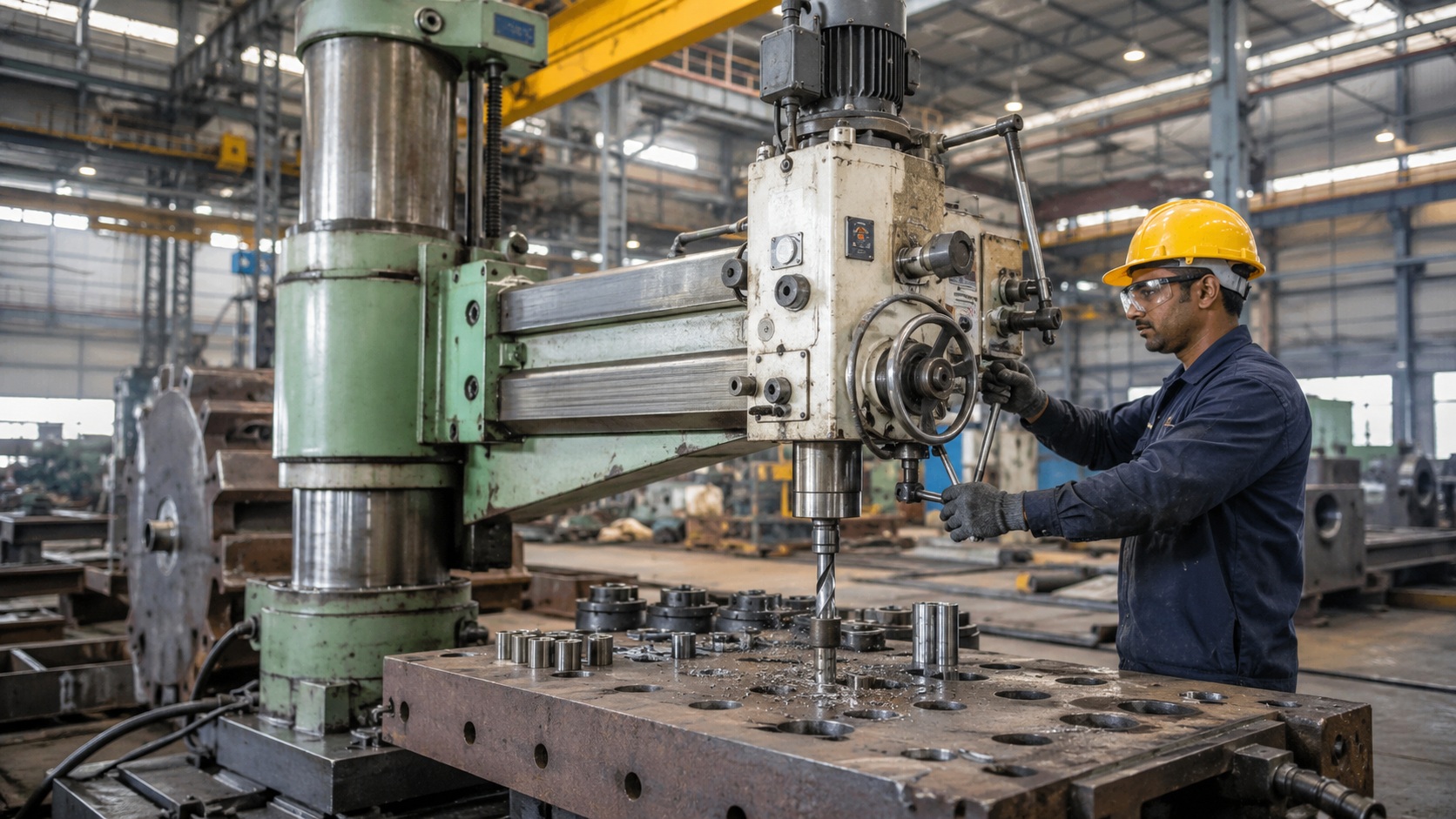
In many manufacturing and fabrication workshops, a radial drilling machine is more than just a tool for making holes. It is a versatile industrial machine used for drilling, threading, finishing, enlarging, and precision hole-making operations on heavy metal components.
Unlike standard drilling machines, a radial drill machine allows the spindle to move across large workpieces without repositioning the material repeatedly. This saves setup time, improves accuracy, and makes handling heavy components much easier.
In this guide, we’ll explain the common operations performed on a radial drilling machine, where they are used, and why these operations matter in real industrial environments.
What Is a Radial Drilling Machine?
A radial drilling machine is a heavy-duty industrial drill designed for large and heavy workpieces. It features a movable radial arm that rotates around a vertical column, allowing the drill head to reach different positions across the work surface.
Instead of moving a large steel plate or casting manually, the operator moves the drill head to the required location. This makes radial drill machines ideal for:
- Fabrication workshops
- Automotive manufacturing
- Heavy engineering
- Structural steel industries
- Tool rooms
- Shipbuilding
These machines are commonly used for operations that require precision hole positioning on oversized components.
Main Operations Performed on a Radial Drilling Machine
1. Drilling
Drilling is the primary operation performed on a radial drill machine. It involves creating round holes in metal workpieces using a rotating drill bit.
Industrial radial drills are used to create holes in:
- Steel plates
- Structural beams
- Machine frames
- Engine components
- Fabricated assemblies
Depending on the application, operators can create:
- Through holes
- Blind holes
- Deep holes
- Large-diameter holes
Because radial drilling machines support multiple spindle speeds and heavy-duty clamping, they can handle different materials such as mild steel, cast iron, stainless steel, and alloy steel.
2. Reaming
Reaming is a finishing operation used to improve the accuracy and surface finish of an existing drilled hole.
A drilled hole may not always achieve the exact diameter or smoothness required for assembly work. Reaming solves this problem by slightly enlarging the hole to achieve better tolerance and finish.
This operation is commonly used in:
- Precision engineering
- Automotive components
- Tool room applications
- Machine assembly work
Reaming helps ensure that shafts, pins, and fasteners fit correctly without excessive play.
3. Tapping
Tapping is the process of creating internal threads inside a drilled hole.
This operation allows bolts and screws to be fitted directly into metal components without using separate nuts. Radial drilling machines with suitable spindle control can perform tapping efficiently on heavy workpieces.
Tapping is widely used in:
- Machinery manufacturing
- Automotive assemblies
- Fabrication structures
- Industrial equipment production
Proper spindle speed and lubrication are important during tapping to avoid thread damage or tool breakage.
4. Counterboring
Counterboring creates a flat-bottomed enlarged section at the top of an existing hole.
This operation is useful when bolt heads or fasteners need to sit flush inside the surface of a component.
Counterboring is commonly seen in:
- Machine bases
- Heavy equipment
- Structural assemblies
- Industrial fixtures
It improves assembly quality and provides cleaner fitting for industrial fasteners.
5. Countersinking
Countersinking creates a conical opening at the top of a hole.
This operation allows countersunk screws to sit flush with the workpiece surface. It also helps remove sharp edges around drilled holes.
Countersinking is useful in:
- Sheet metal fabrication
- Machine panels
- Precision assemblies
- Structural components
A clean countersunk finish improves both appearance and functionality.
6. Spot Facing
Spot facing is a machining operation used to create a smooth and flat seating surface around a drilled hole.
In industrial fabrication, surfaces are not always perfectly flat. Spot facing ensures that washers, bolts, and nuts sit properly during assembly.
This operation is especially important in:
- Heavy engineering
- Structural fabrication
- Equipment assembly
- Construction machinery
Proper spot-facing improves fastening stability and load distribution.
7. Boring
Boring is used to enlarge and accurately finish an existing hole.
Unlike standard drilling, boring improves:
- Hole alignment
- Diameter precision
- Surface finish
- Concentric accuracy
Boring operations are often required for:
- Large machine parts
- Bearing housings
- Engine components
- Precision industrial assemblies
Radial drill machines are suitable for boring large components that are difficult to reposition manually.
8. Trepanning
Trepanning is used to create large-diameter holes while removing less material compared to conventional drilling.
Instead of cutting the entire hole area, trepanning cuts only the outer ring of the hole. This reduces:
- Power consumption
- Material waste
- Machining load
Trepanning is commonly used in:
- Heavy fabrication
- Pressure vessel manufacturing
- Shipbuilding
- Structural engineering
Why Multiple Operations Matter in Industrial Manufacturing
One of the biggest advantages of a radial drilling machine is its ability to perform multiple machining operations on the same setup.
This improves:
- Production speed
- Accuracy
- Workflow efficiency
- Operator productivity
For large workpieces, repeated repositioning can waste time and reduce precision. A radial arm drill minimizes unnecessary handling by bringing the tool directly to the workpiece.
This is especially useful in industries dealing with:
- Large steel plates
- Heavy castings
- Structural frames
- Fabricated assemblies
Industries That Commonly Use Radial Drilling Machines
Radial drill machines are widely used across multiple industries because of their flexibility and heavy-duty performance.
Manufacturing and Fabrication
Used for drilling and finishing structural steel components, machine frames, and fabricated parts.
Automotive Industry
Helpful for machining engine blocks, suspension components, chassis parts, and tooling fixtures.
Heavy Engineering
Suitable for oversized industrial components that require accurate hole positioning.
Shipbuilding and Marine
Used for drilling large steel plates, deck structures, and marine equipment.
Tool Rooms
Supports precision hole-making and finishing operations for jigs, fixtures, and tooling components.
Radial Drill Machine vs Pillar Drill Machine
Although both machines perform drilling operations, they are designed for different workshop requirements.
| Feature | Radial Drill Machine | Pillar Drill Machine |
| Workpiece Size | Large and heavy | Small to medium |
| Spindle Reach | Adjustable radial arm | Fixed position |
| Flexibility | High | Limited |
| Heavy-Duty Operations | Suitable | Limited |
| Multi-Operation Capability | Extensive | Basic operations |
If your workshop handles large steel structures or heavy components, a radial drill machine is usually the more practical choice.
Common Mistakes to Avoid During Radial Drilling Operations
Even a high-quality industrial drill machine can produce poor results if used incorrectly.
Using Incorrect Spindle Speed
Wrong RPM settings can damage tools and affect hole quality.
Improper Clamping
Loose workpieces can cause vibration, inaccurate holes, and safety risks.
Poor Lubrication
Insufficient coolant or lubrication increases tool wear and heat generation.
Overloading the Machine
Using small-capacity machines for oversized operations can reduce machine life.
Using Dull Cutting Tools
Worn tools reduce machining quality and increase power consumption.
Proper maintenance and correct operation improve both productivity and machine lifespan.
How to Choose the Right Radial Drilling Machine
Before selecting a radial drill machine, consider:
- Maximum drilling diameter
- Workpiece size and weight
- Required spindle speed range
- Material type
- Arm reach
- Motor power
- Tooling compatibility
Choosing the correct machine helps avoid production bottlenecks and unnecessary operational costs.
Final Thoughts
A radial drilling machine is one of the most versatile machines used in industrial manufacturing and fabrication. Beyond standard drilling, it can perform reaming, tapping, boring, counterboring, countersinking, spot facing, and other precision operations on large workpieces.
For workshops dealing with heavy engineering, structural fabrication, automotive manufacturing, or industrial assembly work, a radial drill machine improves productivity, accuracy, and operational flexibility.
Understanding these operations helps manufacturers select the right machine and optimize machining efficiency for long-term production needs.
Frequently Asked Questions
Can a radial drilling machine perform tapping operations?
Yes. Many radial drill machines support tapping operations for creating internal threads in metal components.
What is the difference between reaming and boring?
Reaming improves the finish and size accuracy of a drilled hole, while boring enlarges and aligns an existing hole more precisely.
Which industries commonly use radial drilling machines?
Fabrication, automotive, shipbuilding, heavy engineering, construction equipment manufacturing, and tool rooms commonly use radial drill machines.
Can radial drill machines handle large steel plates?
Yes. Radial drilling machines are specifically designed for large and heavy workpieces that are difficult to reposition manually.
What materials can be machined on a radial drill machine?
These machines can work on mild steel, cast iron, stainless steel, aluminium, alloy steel, and other industrial metals.
Looking for a Heavy-Duty Radial Drilling Machine?
If your workshop handles fabrication, automotive components, structural steel, or heavy engineering applications, choosing the right radial drill machine can improve productivity and machining accuracy.
Explore heavy-duty radial drilling machines from Berlin Machineries with capacities ranging from 40 mm to 125 mm, installation support, and pan-India delivery for industrial workshops and manufacturing facilities.
