
Sinker EDM vs Wire EDM: Which Machine Is Right for Your Job?
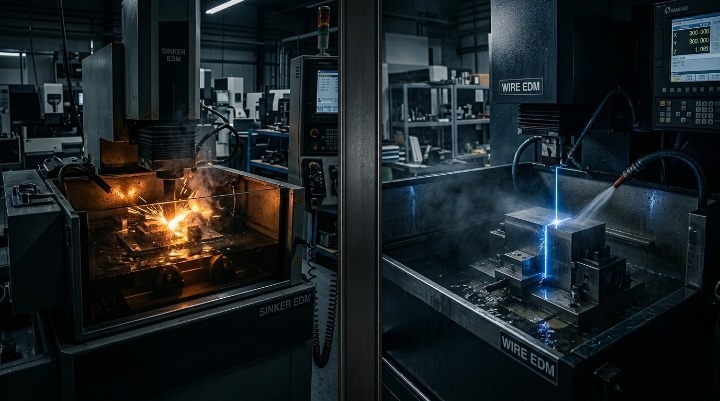
Sinker EDM and Wire EDM both use electrical sparks to cut metal, but they solve very different problems. Sinker EDM burns 3D cavities into a workpiece using a shaped electrode. Wire EDM cuts precise 2D profiles using a thin wire. Choosing the wrong one wastes time, money, and material. Read this guide to understand the key differences and pick the right machine for your job.
You’ve got a hardened D2 steel block on your machine table. The part drawing shows deep ribs, sharp internal corners, and a blind cavity that goes 80mm into the workpiece. You look at your Wire EDM and think: “Can this handle it?”
The answer is no. And that wrong choice costs you a full day of setup, a spoiled workpiece, and a delayed delivery.
This is one of the most common mistakes in tool rooms across India. Engineers understand that both Sinker EDM and Wire EDM use electrical discharge machining (EDM). But they treat the two machines as interchangeable. They are not.
Sinker EDM vs Wire EDM is not just a comparison of two machines. It is a decision that directly affects your part quality, production speed, and cost. Get it right, and your tool room runs smoothly. Get it wrong, and you are reworking parts and missing deadlines.
Let’s break it down clearly, section by section.
What Is Sinker EDM and How Does It Work?
Electrode sinks into the workpiece
The electrode is machined to the exact negative form of the shape you need. When sunk into hardened metal using controlled spark erosion, it burns that 3D geometry precisely into the workpiece.
Zero cutting force
There is no physical contact between the electrode and the workpiece. The sparks do all the work. This is why Sinker EDM reaches places no other cutting tool can go.
Berlin Machine’s ZNC Spark EDM and CNC Spark Mirror EDM machines are built around this exact process. The CNC Spark EDM (Bed Movement) uses a box-type mainframe with multi-layer stiffener distribution to process large molds with consistent accuracy across every cycle.
What Is Wire EDM and How Does It Work?
Wire cuts through the workpiece
Think of it like a vertical band saw, except the “blade” is an invisible spark. The wire travels from a supply spool, through the workpiece, and onto a takeup spool continuously.
Wire never dulls mid-cut
Because fresh wire is always feeding through, there is no tool wear mid-operation. You get consistent cutting performance from the first pass to the last, across the entire batch.
Berlin Machine’s Premium Servo Series CNC Wire Cut EDM machine uses high-performance servo motors and a CNC multi-cut controller to deliver cutting accuracy of 0.015 to 0.020mm and a multi-cut surface finish of Ra less than 1.5. It handles wire diameters from 0.12mm to 0.25mm, giving you control over both fine detail cutting and faster rough passes.
Sinker EDM vs Wire EDM: What Are the Core Differences?
The single biggest difference is this: Sinker EDM creates cavities. Wire EDM makes cuts. Both machines cut without force. Both handle hardened steel, carbide, and exotic alloys. But the application decides which one you need.
| Feature | 🔶 Sinker EDM | 💡 Wire EDM |
|---|---|---|
| Cut Type | 3D blind cavity / pocket | 2D through-cut profile |
| Tool / Electrode | Shaped copper or graphite electrode | Continuous brass or molybdenum wire |
| Part Geometry | Deep ribs, bosses, blind holes, closed pockets | Punches, dies, profiles, gears, through-slots |
| Material Access | Closed or blind features | Requires wire entry / exit point |
| Surface Finish | Good to mirror finish (with finishing passes) | Excellent Ra < 1.5 (multi-cut) |
| Accuracy | Micron-level, depends on electrode accuracy | 0.006mm to 0.020mm depending on series |
| Setup | Electrode must be designed and machined first | Direct from CAD / DXF file |
| Best For | Injection molds, die casting molds, cavities | Press tools, stamping dies, precision profiles |
Which Jobs Are Best Suited for Sinker EDM?
Injection Mold Cavities
A plastic injection mold has deep internal pockets with ribs, bosses, and fine details. A wire cannot enter a closed pocket. The electrode can. It is machined to the exact shape of the cavity and sunk into hardened tool steel to replicate the geometry perfectly.
Die Casting Molds for Automotive and Aerospace
These molds have deep undercuts, draft angles, and surface finishes that must stay consistent across thousands of cycles. Sinker EDM produces stable, repeatable cavities that hold up in production without degradation.
Narrow Slots and Deep Ribs
If a rib in your mold is 1.5mm wide and 40mm deep, no end mill reaches the bottom cleanly. A thin graphite electrode can. This is a daily scenario in automotive mold rooms and plastics manufacturing across India.
Hard Materials Already in Heat-Treated Condition
Sinker EDM does not care about hardness. Whether it is D2 at 62 HRC or M2 high-speed steel, the spark erosion process cuts through it. You can heat-treat your workpiece first, then machine the cavity, eliminating distortion from post-machining heat treatment.
Berlin Machine’s CNC Spark EDM machines are built for exactly these applications. The box-type mainframe with wide base and symmetrical bed gives the structural stability needed when processing large, heavy mold plates in continuous production.
Which Jobs Are Best Suited for Wire EDM?
Press Tools and Stamping Dies
A blanking die set needs a punch and die plate that match perfectly with a clearance of just a few microns. Wire EDM cuts both from the same programmed path, ensuring a perfectly matched set every time without secondary fitting.
Gear Profiles and Involute Forms
These profiles need to be mathematically precise. Wire EDM follows the exact CNC program without deflection or tool wear, giving you consistent tooth profiles across every part in the batch, whether it’s 10 pieces or 1,000.
Medical Devices and Aerospace Components
These industries demand tight tolerances, traceability, and clean surface finishes. Wire EDM provides all three without contaminating the part with cutting forces or heat-affected zones from friction-based machining.
Hardened Steel, Carbide, and Exotic Alloys
Wire EDM handles materials that destroy conventional cutting tools. As long as the material conducts electricity, the wire can cut it. Tool steels, titanium, Inconel, and tungsten carbide are all fair game.
Multi-cut passes on the FZT Series Wire Cut EDM bring the finish down to Ra less than 1.5 without secondary polishing. To understand how Wire EDM handles hardened materials on the shop floor, our detailed guide on how Wire EDM cuts hardened steel explains it step by step.
How to Choose Between Sinker EDM and Wire EDM
Ask yourself these five questions before routing any job to an EDM machine. One honest answer to each question is usually enough to make the right call.
If yes, Wire EDM is likely the right choice. If no (it’s a blind cavity or closed pocket), you need Sinker EDM.
2D profiles (punches, dies, gears, slots) go to Wire EDM. 3D cavities (mold pockets, deep ribs, blind holes) go to Sinker EDM.
Wire EDM gives Ra less than 1.5 with multi-cut passes. Sinker EDM can achieve mirror finish (Ra less than 0.2) with fine finishing electrode passes.
Both machines handle hardened materials well. If you need to machine after heat treatment without distortion, both are equally suitable.
Wire EDM is ideal here. Program once and cut both the punch and die plate on the same path for a perfectly matched set.
In many tool rooms, both machines are used in sequence. Sinker EDM roughs out the mold cavity. Wire EDM cuts the runner system, gates, and ejector pin holes. This combination gives you the best of both processes on a single mold.
Why the Right EDM Machine Partner Matters as Much as the Machine
Choosing between Sinker EDM and Wire EDM is one decision. Choosing the right manufacturer is another, and it affects you for the entire life of the machine.
A machine that runs accurately on day one but has poor service support will cost you far more in downtime than you saved on the purchase price. This is something we hear regularly from customers who switched to Berlin Machine from other brands.
Berlin Machine has been manufacturing EDM machines in Pune since 2005. With 5,000 plus installations across automotive, aerospace, tool room, and precision engineering applications, we understand what Indian manufacturers need: stable cutting performance, reliable machines, and quick local service.
Our complete EDM machine range covers Wire Cut EDM (FDK, Premium Servo, FZT, Super, SF Series), Spark EDM (ZNC, CNC Bed Movement, Column Movement, Double Head Mirror EDM), and EDM Drill machines. You can build your entire EDM capability under one trusted brand.
Not Sure Which EDM Machine Fits Your Job?
Our team has supported 5,000+ installations across India. Tell us your application and we’ll help you choose the right machine, backed by 20 years of real shop-floor experience.
Get Expert Guidance →Conclusion
The choice between Sinker EDM and Wire EDM comes down to three things: your part geometry, your feature type, and your finish requirement.
Sinker EDM is for 3D cavities, blind features, and complex mold work where the electrode does what no other tool can.
Wire EDM is for precise 2D through-cuts, matched punch-and-die sets, and profiles that need tight tolerances and smooth surface finish.
Many production tool rooms need both. When used together, they cover nearly every precision machining requirement you’ll face on the shop floor.
If you want guidance on which machine fits your current or upcoming jobs, reach out to the Berlin Machine team. We’ll help you match the right machine to your real production needs, not just the datasheet. Get in touch with Berlin Machine today.
