
Choosing Your Next Industrial Drill: Radial Arm vs. Upright Vertical Drilling Machinery
In a high-output manufacturing or fabrication unit, your choice of boring and machining equipment dictates your entire cycle time. Picking the wrong setup creates major production bottlenecks, accelerates tool wear, and compromises workshop safety.
When upgrading a facility or bidding on heavy engineering contracts, production managers consistently face a critical decision: Should we invest in a flexible radial arm drill or a traditional upright vertical drilling machine?
The quick answer comes down to material handling: Choose an upright vertical machine if your operators can easily lift and position the components by hand. Choose a radial arm system when the workpiece is too massive, heavy, or wide to move safely between holes.
Let’s break down how these two designs function on a live shop floor so you can allocate your machinery budget with absolute confidence.
The Structural Difference: Moving the Work vs. Moving the Tool
To understand which layout fits your production blueprints, it helps to examine how each machine handles the alignment of a hole.
The Upright Vertical Drill Press (Pillar Drill)
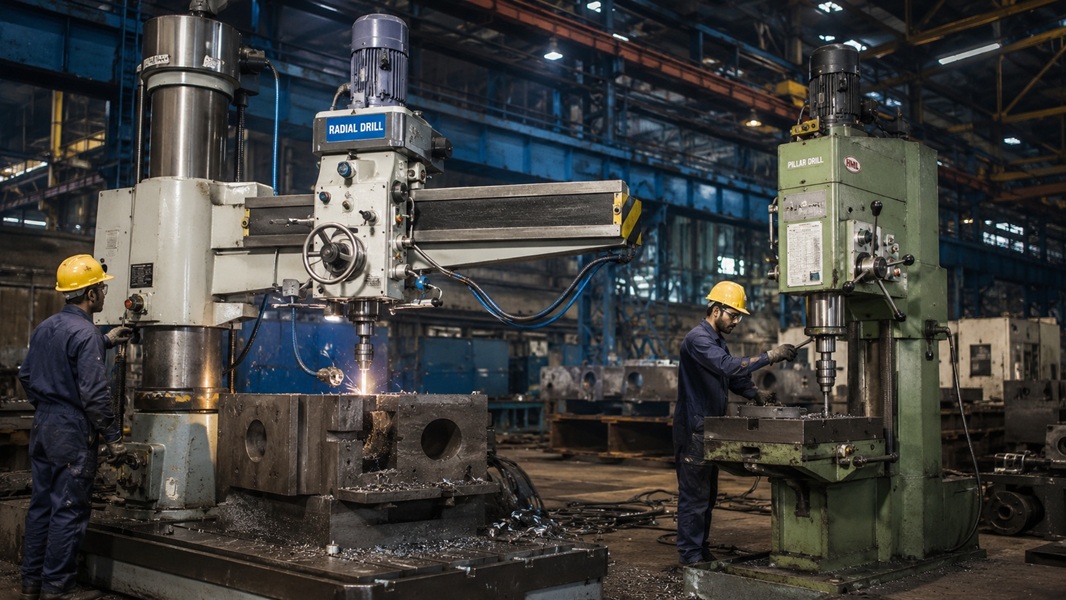
On a standard vertical drilling machine, the spindle head remains in a permanently fixed position. The spindle moves strictly upward and downward along a vertical column. To align a marked hole with the drill bit, the machine operator must manually slide, push, or hoist the workpiece across the worktable. Because there is zero lateral movement in the drill head, the machine’s capacity is strictly limited by how much weight the table can support and how easily an operator can manipulate the raw material.
The Radial Arm Drilling Machine
A radial drilling system reverses this dynamic entirely. The workpiece is securely clamped flat onto a heavy box table or a low baseplate resting directly on the shop floor. It does not move. Instead, the machine features a heavy vertical column supporting a balanced horizontal arm. This arm can swing a full 360° around the column, while the entire gear-driven drill head glides smoothly left and right along the arm.
By combining the rotating arm with the sliding head, the operator can effortlessly position the spindle over any precise coordinates on a massive component without ever unclamping the part.
Head-to-Head Comparison: 5 Crucial Shop Floor Metrics
To make a practical decision, look past basic textbook definitions and analyze how these distinct mechanical configurations affect daily operating costs, safety, and output.
1. Workpiece Weight and Scale Handling
- Vertical Drill Press: These units are optimized for small-to-medium components (typically under 50 kg to 100 kg) that can be easily loaded by a single operator or a small jib crane.
- Radial Drilling Machine: Built specifically for massive steel frames, structural plates, engine blocks, and heavy castings that weigh anywhere from 500 kg to over 25,000 kg. Because the part remains static on the base, you eliminate the safety hazards and structural stresses of constantly rigging and shifting heavy loads with a forklift or overhead crane just to drill a second hole.
2. Operational Reach and Setup Efficiency
- Vertical Drill Press: Since the column is fixed, these machines offer no lateral reach. If you need to drill a pattern of eight holes into a component, the operator must unclamp the part, physically reposition it, verify alignment, and re-clamp it eight separate times. This creates substantial hidden labor costs.
- Radial Drilling Machine: Boast massive spindle-to-column clearances, often ranging from 800 mm to 4,000 mm depending on the model. This allows an operator to mount a complex assembly once and execute drilling, tapping, and reaming across a wide surface area in a single setup, drastically slashing cycle times.
3. Hole Diameter and Heavy Boring Capacities
- Vertical Drill Press: Generally engineered for lighter, high-speed jobs. While heavy-duty pillar drills exist, most standard workshop models cap out at drilling diameters of 40 mm to 50 mm in mild steel.
- Radial Drilling Machine: Equipped with high-torque, all-geared drive heads and robust columns designed to absorb intense cutting forces. They regularly drive large-diameter bits and boring bars through tough alloys, handling hole diameters stretching from 50 mm up to 125 mm without stalling or inducing structural vibration.
4. Versatility of Operations (Multitasking Capability)
- Vertical Drill Press: Highly efficient for straightforward, vertical holes. However, their rigidity makes them less adaptable for complex geometries.
- Radial Drilling Machine: Act as a versatile multi-tool for tool rooms. Features like a swiveling drill head allow you to tilt the spindle to execute precision compound-angle holes without building expensive custom fixtures. They also provide the low-speed, high-torque gear steps required for heavy tapping, precision reaming, counterboring, and spot-facing.
5. Floor Space Requirements and Safety Factors
- Vertical Presses: Feature a highly compact footprint. They easily slip into tight workshop corners and run cleanly in small job shops.
- Radial Systems: Require a dedicated clearance zone to accommodate the full swing arc of the horizontal arm. While they take up more floor space, they significantly improve overall shop floor safety by minimizing the need to move awkward, sharp-edged steel fabrications across the factory floor.
Practical Selection Matrix
| Operational Factor | Vertical / Pillar Drill Press | Radial Arm Drilling Machine |
|---|---|---|
| Ideal Workpiece Weight | Under 100 kg (Easily repositioned) | 400 kg to 28,000+ kg (Static setups) |
| Maximum Hole Diameter | Typically up to 40 mm or 50 mm | Broad capacity from 40 mm up to 125 mm |
| Spindle Flexibility | Fixed position; strictly vertical travel | 360° swing arc with horizontal travel |
| Primary Applications | Small job shops, light fabrications, maintenance | Automotive, shipbuilding, heavy infrastructure |
| Setup Approach | Move workpiece to align with the spindle | Move spindle to align with the workpiece |
Operational Pro-Tips for Maximum Tooling Lifespan
When operating high-torque drilling equipment, practicing basic shop-floor discipline directly preserves your machinery investment:
- Never Skimp on Clamping Rigidity: When running large-diameter drill bits or boring bars on a radial machine, always engage the hydraulic clamping mechanisms for the column and arm. If the arm flexes even a fraction of a millimeter under load, it creates micro-chatter that instantly chips carbide tooling and compromises hole circularity.
- Verify Tooling Standards Early: Ensure your existing inventory of drill chucks, arbors, and taper-shank bits matches the machine’s internal spindle taper (such as Morse Taper MT4, MT5, or MT6). Factor any required adaptors or new tooling sets directly into your initial procurement budget.
- Utilize Mechanical Depth Stops: For blind holes or counterbored seats where mating parts must sit flush, utilize the built-in mechanical depth stop. Setting this mechanism once guarantees depth consistency across hundreds of consecutive parts, eliminating operator guesswork.
Match a Machine to Your Production Blueprints
Selecting the right machine capacity saves thousands of rupees in manual labor, prevents premature tool failure, and keeps your production schedules moving predictably.
If your facility is expanding into mid-to-heavy fabrication, automotive component manufacturing, or structural infrastructure work, matching your exact material thickness and arm reach requirements is the critical first step.
Berlin Machineries provides an engineered lineup of 7 heavy-duty radial drilling models, spanning drilling capacities from 40 mm up to 125 mm, built with robust hydraulic clamping systems and all-geared spindle heads.
To find the exact motor power, weight stability, and spindle-to-column distance required for your specific workshop projects, visit the Berlin Machineries Radial Drilling Machine Selection Guide. You can download comprehensive technical specifications, explore standard included accessories, and request an engineered quote for ready-stock models shipping from Pune with complete pan-India installation and after-sales support.
Frequently Asked Questions
Can a radial drilling machine be used for small workpieces?
Yes. Radial drills handle small parts easily by utilizing an adjustable box table clamped to the base plate. However, if your shop only processes small components, a radial drill is less cost-effective due to its higher power consumption and larger floor space requirements compared to a vertical press.
Why do radial drilling machines use all-geared heads instead of belts?
Belts can slip under heavy loads, causing the drill bit to bind or stall inside tough materials. All-geared heads use precision-matched steel gears to deliver consistent, unbroken torque directly to the spindle. This is essential for driving large bits at low RPM and for high-torque thread tapping.
What is the advantage of a swiveling drill head?
A swiveling head allows the spindle to tilt at an angle relative to the base plate. This means you can drill angled holes into complex parts (like engine brackets or heavy structural joints) without needing to tilt or prop up the heavy workpiece itself.
