

What Is a Milling Machine Used For? Types, Applications & Industrial Uses
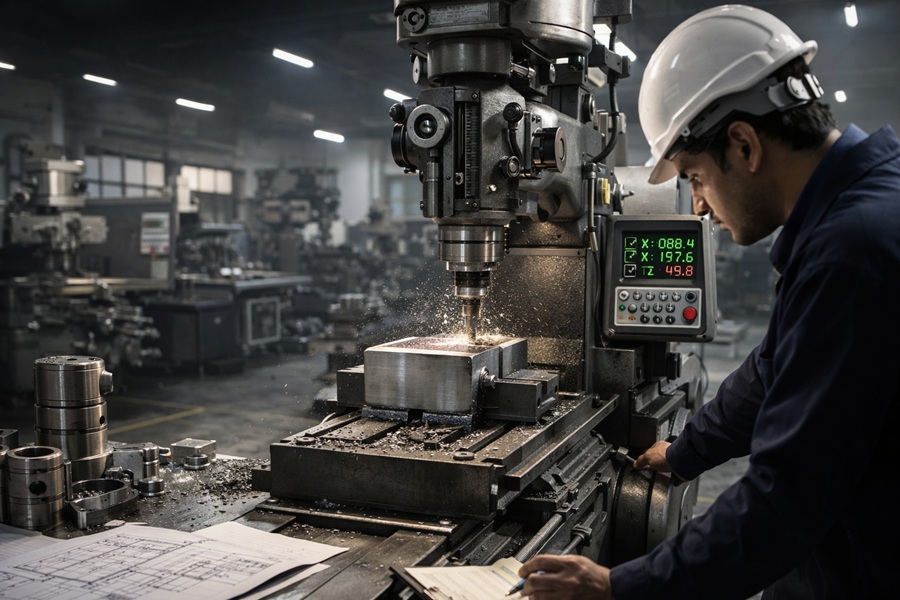
A milling machine removes material from a workpiece using a rotating cutter to create flat surfaces, slots, holes, contours, and complex shapes. It’s the most versatile metal cutting machine in any workshop. The right type depends on your spindle requirement, table size, and production volume. This guide covers every major type, real industrial applications, engineering quality factors, and how to match the machine to your job.
You bought a milling machine. Good price. Decent brand. It arrived on time.
Three months later, it’s fighting you on every job. The spindle vibrates under load. The slideways have lost their feel. The parts you’re producing are just within tolerance — never comfortably inside it.
Sound familiar?
This is one of the most common stories in workshops across India. The buyer focused on price. They skipped the harder questions: What is this machine actually built for? Does it match my spindle requirement? Will it hold accuracy after 5,000 hours of cutting?
A milling machine is only as good as the job it lets you do. That’s not a slogan. It’s an engineering reality.
This guide breaks down exactly what a milling machine is used for, which type matches which job, what separates a machine that lasts a decade from one that fades in two years, and what specs you must check before you buy.
No jargon. No fluff. Just what you need to know.
What Is a Milling Machine and How Does It Work?
A milling machine removes material from a workpiece using a rotating multi-point cutting tool. The cutter spins while the workpiece is held fixed on a table. The table moves in X, Y, and Z directions to feed the workpiece into the cutter — producing precisely shaped parts with flat surfaces, slots, holes, contours, and complex geometry.
That’s the simple version. Here’s what matters for your workshop.
The spindle holds the cutter. The table holds the workpiece. The knee or column controls vertical height. The leadscrews drive the table in X and Y.
Every movement affects accuracy. Every component in that chain needs to be built to a tight standard to deliver consistent results.
Milling is different from drilling (which only cuts vertically) and turning (which spins the workpiece, not the cutter). A milling machine can drill, bore, ream, slot, face, and contour — often without changing setups. That multi-operation capability is exactly why it belongs in every serious machine shop.
The spindle taper is a detail most buyers overlook. It determines what tooling you can run and how much cutting force the spindle can take. We cover that in a dedicated section below.
What Are the Main Types of Milling Machines?
Quick Answer
There are six primary types of milling machines: Turret Mill, Vertical Knee Type, Horizontal Knee Type, Bed Mill, Ram Turret Mill, and DRO Mill. Each is built for a specific kind of work. The right choice depends on your application, spindle requirement, and production volume.
Turret Milling Machine is the compact workhorse of the toolroom. It handles drilling, boring, reaming, and milling in one machine. Easy to operate and simple to maintain. It runs an NT30 or R8 spindle and suits small to mid-scale shops well.
Vertical Knee Type Milling Machine gives you more XYZ travel and higher spindle power. Built for versatility and precision across a wide range of milling tasks, from flat surfaces to complex contours. Spindle tapers range from ISO40 to ISO50. Power goes from 4 kW to 11 kW.
Horizontal Knee Type Milling Machine is for heavy-duty production. The horizontal spindle delivers higher torque and longer table travel. Table sizes go up to 2000 x 500mm. This is the machine for large workpieces and high-volume batch runs.
Bed Milling Machine keeps the workpiece rigid. The table moves only longitudinally. The head moves vertically. That combination delivers exceptional stability for angular cuts and CNC-compatible work. It uses an NST40 spindle and Meehanite cast construction.
Ram Turret Milling Machine has a head that swivels in multiple directions. That flexibility lets you reach surfaces and angles that a standard turret mill cannot. It swivels up to ±45 degrees and suits complex, multi-face setups.
DRO Milling Machine adds a Digital Readout system on all three axes. You get real-time position feedback. Setups are faster. Repeatability is sharper. For precision work with tight tolerances, DRO is not optional — it’s essential.
| Machine Type | Spindle Taper | Power Range | Best For |
|---|---|---|---|
| Turret Mill | NT30 / R8 | 1.5 – 3 kW | Toolroom, general milling |
| Vertical Knee Type | ISO40 / ISO50 | 4 – 11 kW | Versatile production milling |
| Horizontal Knee Type | ISO50 | Up to 15 kW | Batch production, large parts |
| Bed Mill | NST40 | Varies | CNC-ready, angular work |
| Ram Turret Mill | MT3 | Light duty | Complex setups, hard-to-reach |
| DRO Mill | NT30 | 3 kW | Precision, high repeatability |
What Is a Milling Machine Used For? Real Industrial Applications
Quick Answer
A milling machine is used to produce flat surfaces, slots, gear teeth, drilled and bored holes, contours, and complex 3D profiles across virtually every manufacturing industry — from toolrooms and automotive plants to defence workshops and die-making facilities. It handles materials from mild steel to hardened alloy.
Here’s how different industries put it to work every day.
Tool Rooms
Toolrooms depend on milling machines for jigs, fixtures, gauges, and dies. Every component in a press tool or mould starts on a milling machine. The requirements here are consistent accuracy and fine surface finish. A DRO mill or vertical knee type is the standard choice.
Automotive Manufacturing
Engine brackets, transmission housings, cylinder heads, and mounting flanges all require milling at some stage. Automotive production floors run large batch sizes with tight tolerances. Horizontal knee type and bed mills handle these volumes without compromising accuracy.
Defence Manufacturing
Defence components have no tolerance for error. Parts must hit specification every single time. Milling machines in defence shops run complex profiles in high-strength alloys. Machine rigidity and spindle hardness are non-negotiable here.
Die Making
Progressive dies, press tools, and mould cavities all come off milling machines. The surface finish on a mould cavity directly affects the quality of every part it ever produces. DRO mills and vertical knee type machines with fine feed control are the preferred choice.
Job Shops
A job shop gets different work every week. The machine needs to switch from one operation to the next without drama. Turret mills and vertical knee type machines earn their keep here because of their multi-operation flexibility.
General Engineering and Heavy Fabrication
Shafts, flanges, custom brackets, and bearing housings are produced on milling machines daily. For heavy fabrication with large workpieces, horizontal knee type and bed mills — with table sizes up to 2000 x 500mm and 15 kW motors — are purpose-built for the task.
How Do You Choose the Right Milling Machine for Your Workshop?
Choosing the right milling machine comes down to five questions: What are you cutting? What material? What table size do you need? Which spindle taper fits your tooling? How much production volume do you run?
Answer those five questions honestly, and the right machine becomes obvious.
Start With the Application
If you run a toolroom with jigs, fixtures, and gauges, a turret mill or DRO mill fits well. If you’re doing production runs of automotive parts, you need a vertical or horizontal knee type with auto feed. If you process large mold plates, a bed mill is the right choice.
The application tells you what the machine must do. The spec confirms it can do it.
Match the Spindle Taper to the Load
The spindle taper controls how tooling sits in the spindle and how much cutting force the machine can handle.
| Spindle Taper | Best For | Load Capacity |
|---|---|---|
| R8 | Light toolroom, imported machines | Light to medium |
| NT30 | General toolroom and machine shop | Light to medium |
| NT40 | Heavier cutting, production milling | Medium to heavy |
| ISO40 | Versatile production, standard tooling | Medium to heavy |
| ISO50 | Heavy-duty production, large parts | Heavy |
| MT3 | Ram turret, lighter operations | Light |
Running heavy cuts on an R8 spindle is a common mistake. You’ll feel it in vibration, chatter, and premature spindle wear.
DRO or Manual?
Manual mills require skilled operators who can read dials accurately and consistently. DRO mills give every operator real-time position data on all three axes. Setup times drop. Repeatability improves. For shops running repeat parts or tight tolerances, DRO pays for itself quickly.
Floor Space vs Output
A turret mill has a smaller footprint. A horizontal knee type or bed mill takes up significantly more floor space. Don’t buy capacity you can’t fit or can’t feed with work.
What Makes a Milling Machine Last? The Engineering That Matters
Two milling machines can look identical on a spec sheet and perform completely differently after two years of use. The difference is in the engineering underneath the paint.
Here’s what separates a machine that holds accuracy for a decade from one that starts drifting in 18 months.
- Induction Hardened and Ground Slideways The X and Y slideways take constant wear from every table movement. Induction hardening adds surface hardness without making the slideway brittle. Grinding brings them to tight dimensional accuracy. Without both, the slideway wears unevenly and positional accuracy starts to drift.
- Turcite-B Coating on Slideways Turcite-B is a low-friction polymer material bonded to the slideway surface. It reduces stick-slip — the jerky movement that causes positioning errors — and extends slideway life significantly compared to uncoated metal-on-metal contact.
- Chrome Molybdenum Alloy Steel Spindle The spindle is under load every time the machine cuts. CrMo alloy steel is hardened and precision ground to handle those loads without deforming. A spindle made from softer material will fail under heavy cutting, often without warning.
- Meehanite GC 275 Cast Iron Frame The machine frame absorbs vibration during cutting. Meehanite-grade cast iron is annealed and stress-relieved after casting. That process removes internal stresses that would otherwise cause the frame to shift over time, compromising the machine’s geometry.
- Phosphor Bronze Double Nuts on Leadscrews Backlash in the leadscrews is the enemy of feed accuracy. Phosphor bronze nuts with backlash adjustment keep the leadscrews tight without creating excessive friction. Hard-wearing material. Long service life.
- Three Power Quill Feeds with Auto Stop For boring and drilling operations, three selectable automatic feed rates with a depth stop give you repeatable results on every cycle. The splined quill pinion shaft supports the feed clutch properly.
Ask any supplier about these six features. If they can’t give you a specific answer on each one, that’s your answer.
Milling Machine Specifications You Must Know Before Buying
Quick Answer
Six specifications define what a milling machine can and cannot do: table size, spindle taper, motor power, XYZ travel, spindle speed, and machine weight. Check all six against your application requirements before you commit to a purchase.
Table Size determines the maximum workpiece you can clamp and machine. Across the Berlin range, table sizes go from 230 x 1067mm on compact turret mills to 2000 x 500mm on horizontal production machines.
Spindle Taper sets your tooling compatibility and cutting force limit. Refer to the spindle taper table in the section above.
Motor Power governs the material removal rate and the heaviness of cuts you can take. The range goes from 1.5 kW on light turret mills to 15 kW on heavy horizontal machines.
XYZ Travel tells you how far the table and head can move. That determines the size of features you can machine in a single setup. Maximum travel in the range reaches 1100 x 700 x 500mm.
Spindle Speed affects surface finish and cutting efficiency. Maximum spindle speeds go up to 4620 RPM. Higher RPM helps with small cutters and fine finishing work.
Machine Weight is a proxy for rigidity. Heavier machines have more mass to absorb vibration. The range goes from 1000 kg to 5200 kg. Don’t underestimate this number.
| Specification | Range Across Models |
|---|---|
| Table Size | 230 x 1067mm to 2000 x 500mm |
| Spindle Taper | R8, NT30, NT40, ISO40, ISO50, MT3 |
| Motor Power | 1.5 kW to 15 kW |
| Machine Weight | 1000 kg to 5200 kg |
| Spindle Speed | Up to 4620 RPM |
| XYZ Travel | Up to 1100 x 700 x 500mm |
| Warranty | 1 Year Standard |
| Delivery | Ready stock / 2 to 6 weeks |
The Bottom Line
A milling machine is not a commodity purchase. Every choice — spindle taper, table size, motor power, frame construction — affects how the machine performs on your floor and how long it stays accurate.
Three things to take from this guide.
- Match the machine to your job, not your budget. A turret mill in a die shop is the wrong tool. A heavy horizontal mill in a five-man toolroom is overkill. Get the fit right.
- Engineering quality is what makes a machine last. Ask about the spindle material, the slideway hardening, and the casting grade before you commit.
- The right supplier asks you questions before they quote. If you’re getting a price before they know your application, that’s a red flag.
The Berlin Machineries team works the other way. Tell them your application, your table size requirement, and your spindle preference. They’ll come back with the right model recommendation and a clear quote within one business day.
Frequently Asked Questions
What is the main purpose of a milling machine?
What is the difference between a turret mill and a knee type milling machine?
Which spindle taper is best for toolroom work in India?
Do I need a DRO milling machine?
How long does a milling machine last?
Berlin Machineries | cncedmmachine.in | 08048976433 | Pune, Maharashtra

Leave a Reply