

Applications of Wire EDM Machine: A Practical Guide for Modern Manufacturers
If you’re in manufacturing, tool making, or precision engineering, you’ve likely faced this situation many times: a component comes in with extremely tight tolerances, sharp internal corners, or hardened steel that your CNC machine simply can’t handle. You try different tools, slower feeds, coolants… but nothing delivers the accuracy you need. Jobs take longer, costs go up, and scrap becomes a constant frustration.
This is exactly where understanding the applications of Wire EDM machine becomes essential. Many manufacturers are aware of EDM as a technology but are unsure when to use it or why it performs better for certain jobs. By learning how Wire EDM works and where it performs best, you can choose the right machining strategy, reduce production time, improve accuracy, and simplify even the most complex jobs.
Wire EDM has become a critical solution for industries where precision, repeatability, and complex geometry cutting are non-negotiable, and this guide explains it in clear, practical terms.
What Is Wire EDM? A Simple Explanation
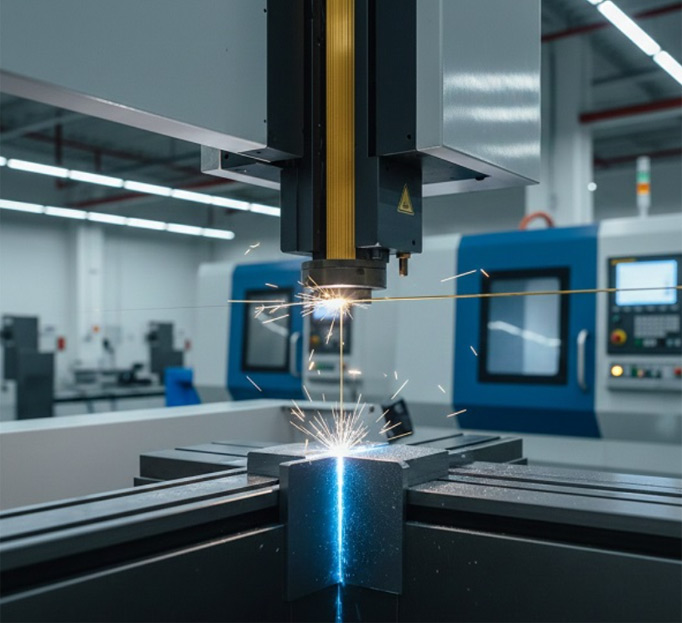
Wire EDM stands for Wire Electrical Discharge Machining. It is a non-traditional machining method that uses a thin, continuously moving wire to cut metal through controlled electrical sparks. Instead of cutting the material with physical force like a CNC machine does, Wire EDM removes material through spark erosion.
This difference is what allows Wire EDM to cut extremely hard materials, achieve micron-level accuracy, and produce fine geometries that are almost impossible on conventional CNC equipment.
Working Principle of Wire EDM (Explained Simply)
The working principle of wire EDM is actually quite straightforward:
- A thin brass or molybdenum wire acts as the electrode.
- The workpiece is submerged in deionized water.
- Electrical sparks jump between the wire and metal surface.
- These sparks melt and vaporize tiny particles, shaping the material.
- Since there is no physical contact, there is no cutting force or tool pressure.
- The wire moves through a CNC-controlled path using a Multicut motion system.
Because of this non-contact cutting method, the machine can easily cut hardened parts, delicate components, or shapes that need very fine accuracy.
Why Wire EDM Is Trusted in Precision Manufacturing
Manufacturing teams prefer Wire EDM for several reasons. It can cut hardened steel, carbide, copper, titanium, Inconel, and other difficult alloys with ease. Accuracy is typically in the 2–5 micron range, which makes it ideal for precision tooling and mold parts. The process naturally produces sharp internal corners, thin profiles, and intricate contours without tool marks. It also offers excellent surface finish, which is crucial for molds, dies, and high-performance components.
This combination of material compatibility, precision, and finish is what makes Wire EDM invaluable in modern industries.
Applications of Wire EDM Machine in Modern Manufacturing
Wire EDM is used across many sectors. Below are the most common and high-value applications.
Mold & Die Manufacturing
Wire EDM is a backbone technology for mold makers. It is used to produce die inserts, punch tools, progressive dies, and injection mold components. The machine’s ability to handle taper cutting and fine profiles makes it essential for complex die geometries.
Aerospace Components
Aerospace parts often use high-temperature materials such as Inconel, titanium, and carbide. Wire EDM handles these alloys effortlessly. It is also used for turbine blade profiles, nozzle parts, and precision slots that cannot be machined through milling.
Automotive Industry
From gear profiles to fuel system components and R&D prototype parts, Wire EDM delivers consistent accuracy. Automotive tool rooms frequently use it for making punches, dies, gauges, and custom fixtures.
Medical & Surgical Instrument Manufacturing
Medical instruments require micro-cutting, small slots, and very clean edges. Wire EDM can machine titanium implants, surgical pins, orthopedic tools, and delicate medical parts with high repeatability.
Electronics & Semiconductor Manufacturing
Wire EDM is widely used for micro components, lead frames, connector slots, and tiny precision parts required in electronic assemblies and semiconductor processing.
Tool Rooms & Precision Engineering Shops
Wire EDM supports jigs, fixtures, gauges, high-precision punches, and production tooling. It is a go-to technology for tool rooms handling complex, intricate, or hardened components.
Complex Geometries Wire EDM Can Easily Produce
One of the biggest advantages of Wire EDM is its ability to create shapes that are nearly impossible for CNC to achieve. The machine handles fine slots, intricate contours, sharp corners, and very small radii without causing any deformation or tool marks. Even heat-treated components retain dimensional stability since no cutting force is applied during the process.
Advantages and Disadvantages of Wire EDM
Like any machining technology, wire EDM has its strengths and limitations.
Advantages include:
- High accuracy and repeatability
- No mechanical cutting force
- Ability to cut hardened and exotic metals
- Excellent surface finish
- Capability to produce complex, delicate profiles
Disadvantages include:
- Slower material removal rate compared to CNC milling
- Works only on electrically conductive materials
Understanding both sides helps manufacturers choose the right process for the right application.
Industry Examples: Components Commonly Made with Wire EDM
Wire EDM is used to manufacture a wide variety of industrial components, including punches, dies, extrusion profiles, microslits, carbide cutting tools, stamping components, injection mold inserts, and medical instrument tips. These parts require precision, stability, and complex geometry — all strengths of Wire EDM.
When to Choose Wire EDM Instead of CNC Machining
Wire EDM is the better choice when the material is very hard, when the geometry is too complex for conventional milling, or when extremely tight tolerances are required. It is ideal for heat-sensitive or delicate components and for mold and die parts where every micron matters. CNC machining is excellent for bulk material removal, but Wire EDM excels in the final precision manufacturing stage.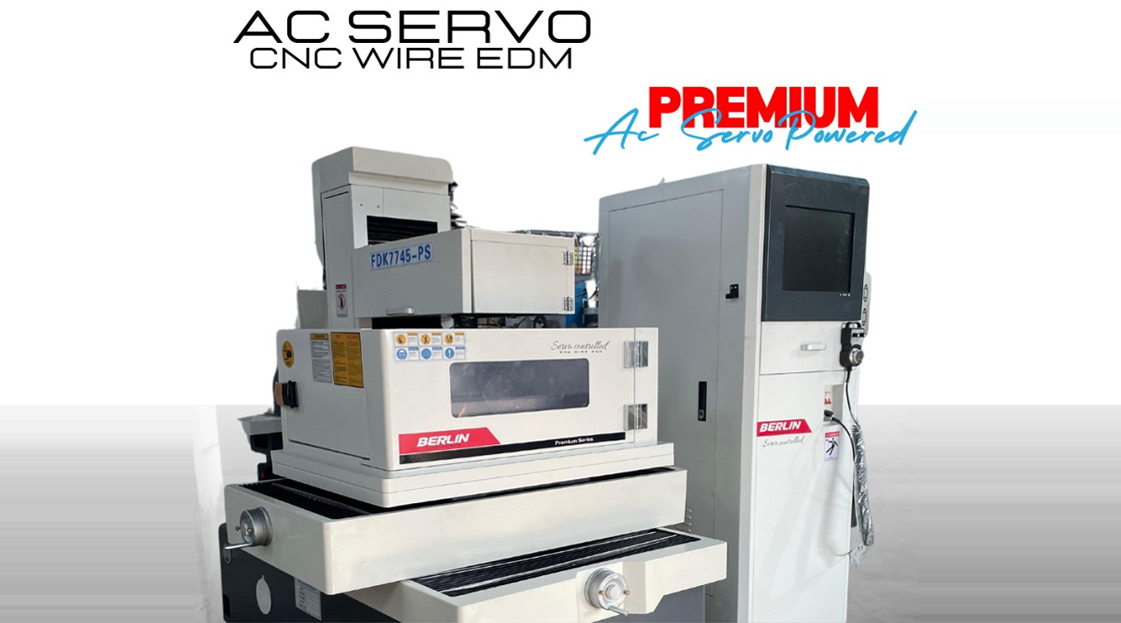
Why Choose Berlin Machineries Wire EDM Machines
Berlin Machineries’ Premium Servo Series Wire EDM machines are engineered for industrial performance. They offer servo-driven stability, ceramic wire guides for long life, and an advanced CNC Multicut controller that integrates with AutoCAD for easy programming.
These machines deliver high accuracy with low maintenance, making them suitable for every application discussed above.
Whether it’s mold making, aerospace components, automotive tooling, or high-precision medical parts, our machines ensure consistent quality and long-term reliability.
Conclusion
Wire EDM plays a vital role in modern manufacturing because of its ability to cut hard materials, produce complex geometries, and maintain micron-level accuracy. Understanding the applications of this technology helps manufacturers make smarter decisions, reduce scrap, and improve part quality.
If your work requires precision, stability, and intricate profiles, explore our Premium Servo Series Wire EDM machines designed for high-performance industrial use.
Frequently Asked Questions (FAQs)
1. What is the main principle of how a Wire EDM machine cuts metal?
Wire EDM cuts metal using a thin, continuously moving wire that creates controlled electrical sparks to erode the material. Unlike CNC, there is no physical contact or cutting force between the wire and the workpiece.
2. What types of materials can Wire EDM machines cut?
Wire EDM can easily cut any electrically conductive material, no matter how hard it is. This includes hardened tool steel, carbide, titanium, Inconel, copper, and other high-temperature or exotic alloys commonly used in aerospace and medical manufacturing.
3. In which industries is Wire EDM most commonly used?
Wire EDM is a key technology in industries that require extreme precision and complex parts. Its most common uses are in Mold & Die Manufacturing, Aerospace (for tough alloys), Medical (for small, delicate instruments), and Tool Rooms for making high-precision gauges and fixtures.
4. What kind of complex shapes can Wire EDM create that a CNC machine might struggle with?
Wire EDM excels at creating shapes that have sharp internal corners, very small radii, intricate contours, and thin slots or profiles. Because it uses no cutting force, it can cut these delicate shapes without deforming the material.
5. What is the typical accuracy level of a Wire EDM machine?
Wire EDM delivers extremely high precision. The typical accuracy range is 2–5 microns, which is essential for creating tight-tolerance tooling, molds, and performance-critical components.
6. What is the main limitation of using a Wire EDM machine?
The main limitations are that it only works on electrically conductive materials and it has a slower material removal rate compared to the high-speed material removal done by CNC milling machines.

Leave a Reply