

CNC EDM Machines : Wire Cut vs Die Sinking vs Spark Erosion – Complete Guide
A CNC EDM machine shapes electrically conductive metals using controlled electrical sparks instead of cutting tools. Manufacturers rely on this process when a part is too hard, too intricate, or too precise for conventional milling or turning. This guide compares the three major machine types — CNC EDM wire cut machine, CNC EDM die sinking machine, and CNC EDM spark erosion machine so buyers, engineers, and production teams can choose the right technology with confidence.
What Is a CNC EDM Machine ?
A CNC EDM machine uses controlled electrical discharges to remove material from electrically conductive workpieces, guided by computer numerical control for precise, repeatable results.
Electrical discharge machining (EDM) works on a simple principle: rapid sparks between an electrode and the workpiece erode material in tiny, controlled amounts. Because the process relies on electrical conductivity rather than mechanical force, it excels with hardened steels, carbides, and other tough alloys that resist conventional cutting tools.
CNC control coordinates electrode or wire movement with discharge timing, so operators can hold tight tolerances on complex geometries without manual intervention. Tool and die shops, mould makers, aerospace suppliers, and medical component manufacturers depend on this precision daily.
How Does a CNC EDM Machine Work ?
The EDM process follows a consistent sequence, whether the machine cuts profiles or sinks cavities :
- Workpiece preparation – the conductive part is clamped and aligned on the machine table.
- Electrode or wire positioning – a wire electrode or shaped tool electrode is set relative to the workpiece.
- Dielectric fluid application – a non-conductive fluid fills the gap between electrode and workpiece.
- Controlled electrical discharge – pulsed current creates sparks that jump across the gap.
- Material erosion – each spark melts and vaporizes a microscopic amount of metal.
- CNC movement and control – the control system guides the electrode path to achieve the programmed shape.
- Flushing of eroded particles – dielectric fluid carries away debris to maintain a clean gap.
- Final precision machining – finishing passes refine surface quality and dimensional accuracy.
This cycle repeats thousands of times per second, allowing EDM machining to produce fine detail without physical cutting force on the part.
Types of CNC EDM Machines
Three machine categories dominate industrial EDM applications, each suited to different geometries :
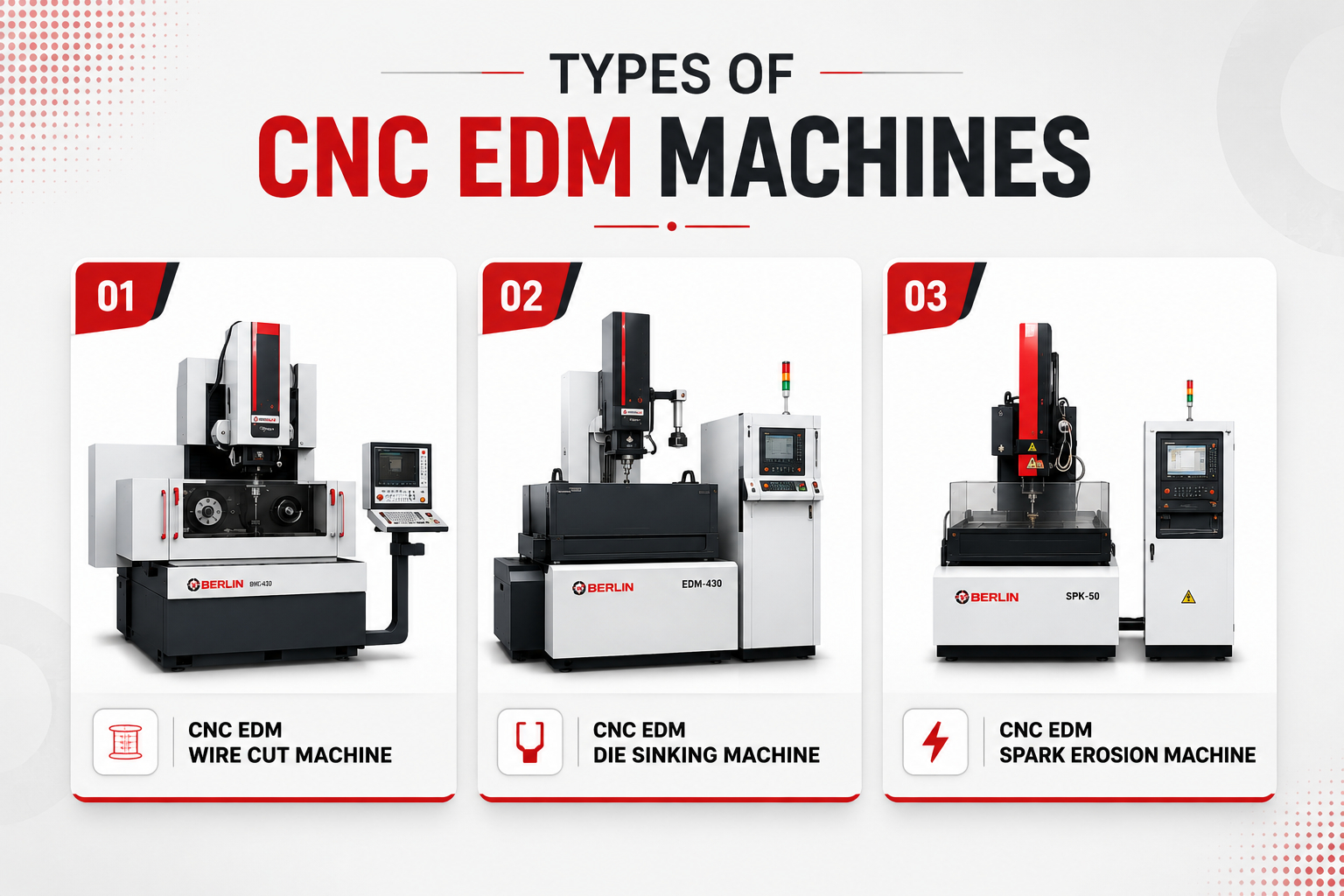
Understanding what each machine does best helps buyers avoid mismatched investments.
CNC EDM Wire Cut Machine: Working and Applications
A CNC EDM wire cut machine uses a thin, continuously moving wire as the electrode. The wire never touches the workpiece; instead, controlled sparks erode a path as the CNC system guides the wire along a programmed profile.
This method suits electrically conductive materials such as tool steels, carbide, titanium, and hardened alloys. Because the wire is constantly renewed, wear does not affect accuracy, making Wire EDM ideal for tight-tolerance, through-cut geometries.
Common applications include :
- Dies and punches
- Precision tooling
- Complex profile components
- Aerospace structural parts
- Automotive tooling components
- Medical device components
- Intricate through-cut shapes
Wire EDM is often preferred in production scenarios requiring fine detail, sharp internal corners, or minimal heat-affected zones, particularly for hardened materials that are difficult to machine conventionally.
Working and Applications
A CNC EDM die sinking machine, also called Sinker EDM, uses a shaped electrode that is pressed into the workpiece through controlled sparking, creating a cavity that mirrors the electrode’s form.
Unlike wire cutting, which produces through-profiles, die sinking excels at blind cavities and complex 3D shapes. The electrode itself typically graphite or copper is machined to the negative of the desired cavity before the EDM process begins.
Typical applications include :
- Mould cavities
- Progressive and forming dies
- Complex 3D contoured shapes
- Blind holes and pockets
- Tool and die manufacturing
- Precision mechanical components
Die Sinking EDM is the preferred choice when a part geometry cannot be produced by a through-cutting method, such as deep cavities with internal detail.
CNC EDM Spark Erosion Machine : How It Differs
Spark erosion is not a separate technology from EDM it is the fundamental mechanism behind all EDM processes, including both Wire EDM and Die Sinking EDM. The term CNC EDM spark erosion machine commonly refers to equipment configured for controlled, electrode-based material removal.
Spark erosion removes material through the same discharge principle described earlier: rapid electrical pulses erode conductive material in a dielectric environment. What distinguishes “spark erosion” terminology is its emphasis on the erosion mechanism itself, often used in contexts involving electrode-based finishing, precision hole drilling, or specialized erosion applications.
In practice, a spark erosion machine may resemble a die sinking setup, using a shaped electrode, or may be configured for other precision erosion tasks. It differs from Wire EDM in that it typically does not use a continuously fed wire, and it differs from standard die sinking in how the electrode and application are configured.
CNC EDM Wire Cut vs Die Sinking vs Spark Erosion
Wire
Shaped electrode
Electrode-based discharge
Profile cutting
Cavity machining
Controlled spark erosion
Complex profiles
Dies and moulds
Precision material removal
Depends on configuration
Through profiles
Blind cavities
Precision erosion
Tooling, aerospace, automotive
Moulds, dies, tooling
Tool and precision manufacturing
Which CNC EDM Machine Should You Choose ?
Machine selection depends on part geometry and production goals, not on brand preference alone.
- Choose Wire EDM for complex through-profile cutting, sharp internal corners, or hardened material components.
- Choose Die Sinking EDM for cavities, blind pockets, and complex 3D mould or die shapes.
- Choose spark erosion equipment based on the specific electrode configuration and erosion application required.
Before deciding, evaluate :
- Workpiece material and hardness
- Component geometry and depth
- Required accuracy and tolerance
- Surface finish expectations
- Production volume
- Part dimensions and fixture requirements
- Automation needs
- Electrode requirements
- Dielectric system compatibility
- CNC control capabilities
- Available after-sales support
Industries Using CNC EDM Machines
CNC EDM technology supports industries that demand precision on hard, conductive materials :
- Automotive – tooling, dies, and precision components
- Aerospace – complex, high-tolerance structural parts
- Medical device manufacturing – fine-detail components
- Tool and die manufacturing – dies, punches, and moulds
- Mould manufacturing – cavity and core production
- Electronics – micro-precision components
- Defence – high-accuracy precision parts
- General precision engineering – custom conductive components
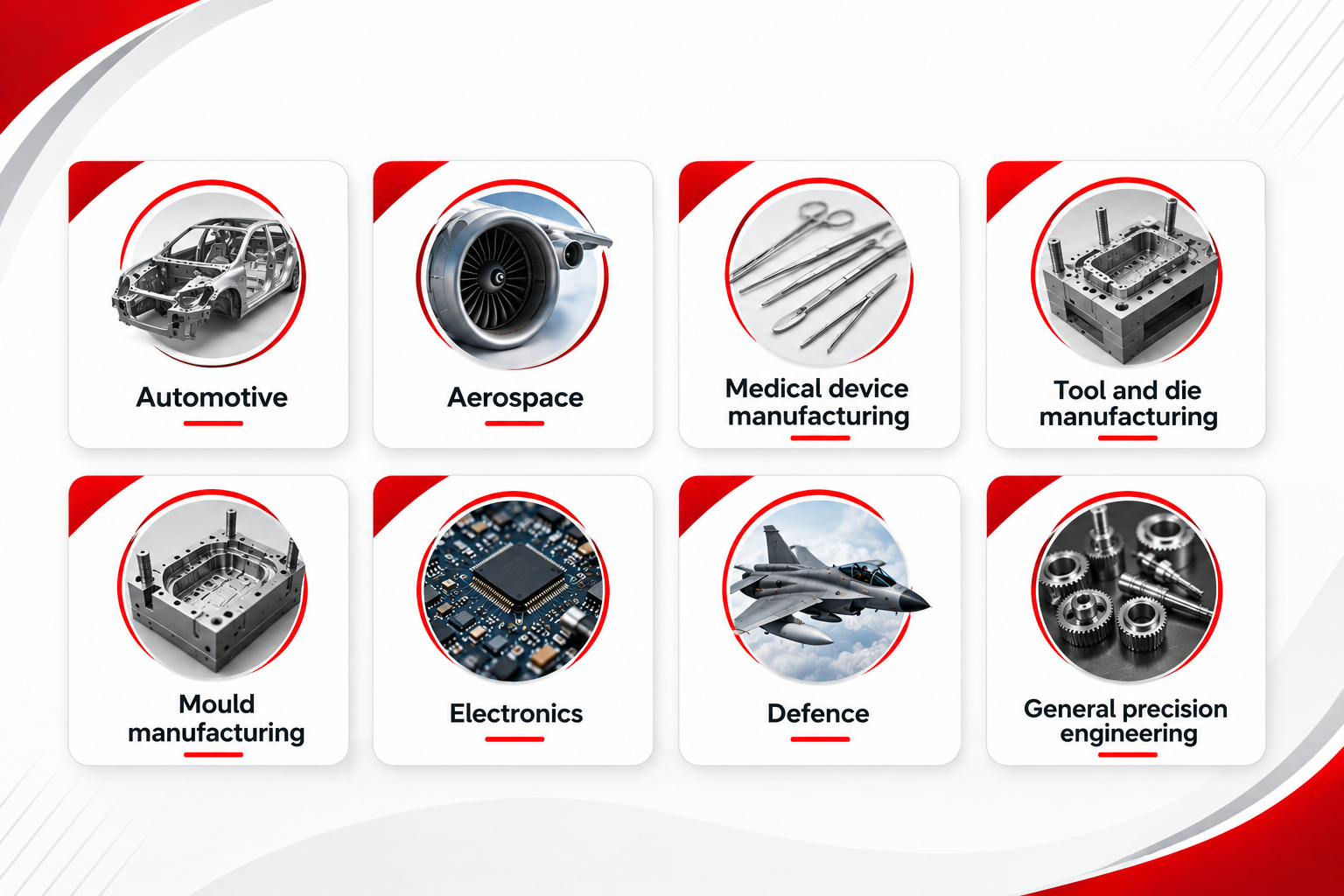
EDM machining gives these industries a reliable way to produce complex geometries and hardened parts that conventional machining struggles to achieve.
Key Factors to Consider Before Buying a CNC EDM Machine
A practical buyer checklist should include :
- Energy efficiency
- Maintenance requirements
- Spare parts availability
- Operator support and documentation
- Training programs
- Warranty terms
- After-sales service quality
- Manufacturer’s engineering experience
- Export and shipping capability
- Delivery and installation support
- Machine construction and rigidity
- CNC control system capability
- Axis configuration
- Cutting or sinking capacity
- Maximum workpiece size
- Accuracy and repeatability
- Surface finish capability
- Automation options
- Wire or electrode system design
- Dielectric and filtration system
An experienced manufacturer should function as a technical partner throughout the machine’s operational life, not just at the point of sale.
Why Choose an Experienced CNC EDM Machine Manufacturer ?
Buyers benefit from working with a manufacturer, supplier, or exporter that demonstrates consistent engineering and support standards. Look for :
- Engineering expertise in EDM design and application
- Rigorous machine quality control
- Application-specific technical support
- Customization capability for unique part requirements
- Installation assistance
- Operator training programs
- Reliable spare parts support
- Ongoing maintenance guidance
- Proper export documentation
- Responsive international customer support
- Consistent manufacturing standards across machines
If you’re evaluating a CNC EDM wire cut machine, die sinking machine, or spark erosion setup for your production line, it’s worth discussing your specific machining requirements with a manufacturer directly. Request technical information, ask about available configurations, and get a clear quotation before committing to a purchase.
Every machining application is different. If you’re weighing a CNC EDM wire cut machine, die sinking machine, or spark erosion setup for your production line, our engineering team can walk through your part geometry, material, and tolerance requirements with you. Get in touch to discuss your specifications and request a tailored quotation.
Frequently Asked Questions About CNC EDM Machines
A CNC EDM machine uses controlled electrical discharges to remove material from electrically conductive workpieces. CNC controls guide the process to produce precise profiles, cavities, and complex components.
A die sinking machine uses a shaped electrode pressed into the workpiece through controlled sparking to create cavities, ideal for moulds, dies, and complex 3D shapes.
It refers to equipment using controlled electrical discharge erosion, the core mechanism behind all EDM processes, often applied to electrode-based precision material removal.
Wire EDM cuts through-profiles using a moving wire electrode. Die Sinking EDM forms cavities using a shaped, stationary electrode. Each suits different part geometries.
Selection depends on workpiece material, part geometry, required accuracy, surface finish, and production volume. Through-profiles favor Wire EDM; cavities favor Die Sinking EDM.
CNC EDM machines process any electrically conductive material, including tool steels, carbide, titanium, and hardened alloys, regardless of hardness.
