

Why Choose Wire Cut EDM Process for Metal Cutting?
Introduction: When Conventional Metal Cutting Starts Failing
If you work in manufacturing, you’ve probably been in this situation before. A part appears great on paper, but when it’s machined, difficulties come up. Cutting tools wear out faster than you think. After heat treatment, accuracy goes down. It’s not possible to get sharp corners on the inside. Even little mistakes might cause distortion, scrap, or having to do the same work over and over.
When you work with tough materials and complicated designs, these problems get worse. These conditions make it hard for traditional metal cutting procedures to work. Manufacturers start looking for better solutions as tolerances get tighter and quality expectations rise. This is when the wire cut EDM method for cutting metal comes into play.
Wire cut EDM doesn’t force tools through hard material like other methods do. It emphasizes on accuracy, reproducibility, and dependability, which are all things that modern production needs.
What Is the Wire Cut EDM Process?
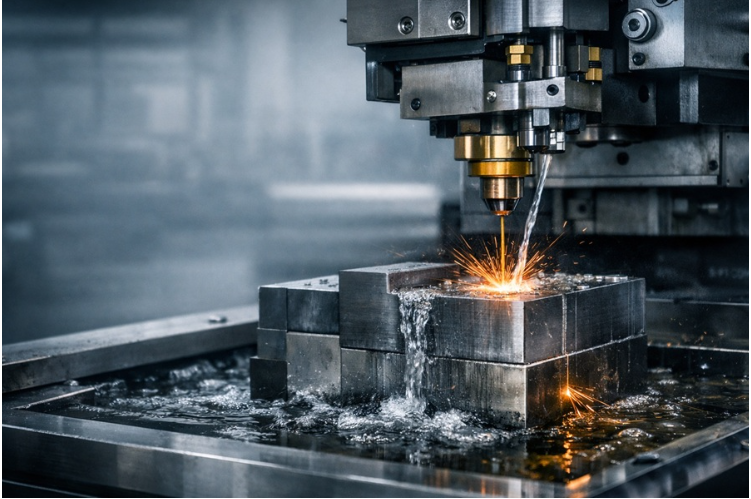
The wire cut EDM process is a type of electrical discharge machining. Instead of cutting with physical force, it removes material using controlled electrical sparks. A thin wire, usually made of brass or molybdenum, moves along a programmed path while electrical discharges erode the metal.
Unlike milling or turning, there is no direct contact between the cutting tool and the workpiece. This is why wire cut EDM is known as a non-contact machining process. The absence of cutting force allows it to machine hard and delicate parts without distortion.
In modern manufacturing, this process is widely used when mechanical cutting methods reach their limits.
Key Problems Wire Cut EDM Solves in Metal Cutting
- Machining hardened and heat-treated metals that quickly damage conventional cutting tools
- Tool wear and dimensional errors caused by cutting forces in traditional machining
- Manual finishing required due to poor edge quality and distortion
- Difficulty in producing complex profiles, narrow slots, and sharp internal corners
- Risk of bending or part deformation during mechanical cutting
Inconsistent results caused by heat and mechanical stress
Wire cut EDM overcomes these challenges by delivering stable, stress-free, and predictable machining results.
Why Manufacturers Choose Wire Cut EDM Over Conventional Machining
Manufacturers don’t switch processes without reason. Wire cut EDM offers several advantages that directly impact quality and cost control.
Because there is no cutting force, tools do not wear out. Accuracy remains consistent across multiple parts. Fully hardened materials can be machined without softening or distortion. This makes the process highly repeatable.
Another key advantage is reduced rework. Parts come out closer to final dimensions, reducing manual finishing and adjustment. Over time, lower scrap rates and consistent quality make wire cut EDM a reliable and cost-effective option for precision metal cutting.
Materials Best Suited for Wire Cut EDM Process
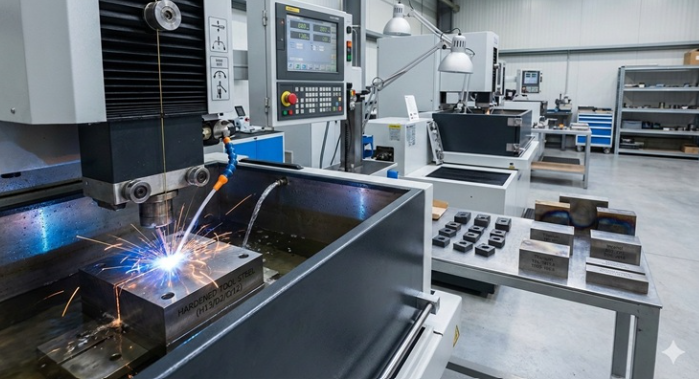
Wire cut EDM works best with electrically conductive materials. This includes a wide range of metals commonly used in manufacturing.
Hardened tool steels such as H13, D2, Cr12, and EN31 are ideal candidates.
Carbide and other wear-resistant materials, which are extremely difficult to machine conventionally, are also well suited for this process.
Exotic alloys used in aerospace and precision engineering can be machined accurately as long as they conduct electricity. This flexibility makes wire cut EDM valuable across multiple industries.
Applications Where Wire Cut EDM Is the Best Choice
- Tool and die manufacturing for press tools, punches, dies, and inserts requiring precise fitment
- Mold making applications involving complex cavities and fine details
- Automotive tooling and components where repeatable accuracy is essential
- Aerospace parts that demand high strength, tight tolerances, and dimensional control
- Medical components requiring precision, consistency, and material integrity
- Final machining after heat treatment to ensure dimensional stability and accuracy
Accuracy and Surface Finish Advantages of Wire Cut EDM
Accuracy is one of the strongest reasons to choose wire cut EDM. Tight tolerances can be achieved consistently, even on hardened materials.
Surface finish depends on cutting parameters and the number of passes. A single cut is often sufficient for general applications. Multi-cut operations improve surface finish and dimensional control further.
Better surface finish improves part performance, reduces friction, and extends tool life in production environments. These benefits are difficult to achieve with conventional cutting methods on hard materials.
Limitations of Wire Cut EDM Process (Honest Perspective)
Wire cut EDM is not the right solution for every situation. It is slower than milling or laser cutting, especially when machining thick sections. Speed is sacrificed for accuracy and control.
The process cannot cut non-conductive materials such as plastics or ceramics. For simple shapes where speed matters more than precision, conventional machining may still be more economical.
Understanding these limitations helps manufacturers choose the right process instead of forcing wire cut EDM into unsuitable applications.
When Should You Choose Wire Cut EDM for Metal Cutting?
- When precision and accuracy are more important than cutting speed
- When machining hardened or heat-treated materials
- When parts have complex geometries, fine details, or sharp internal corners
- When components are sensitive to mechanical stress or distortion
- When conventional machining causes tool breakage or frequent rework
- When consistent quality and repeatability are required across multiple parts
- When reducing scrap and improving long-term production reliability matters
Choosing the Right Wire Cut EDM Machine for Your Application
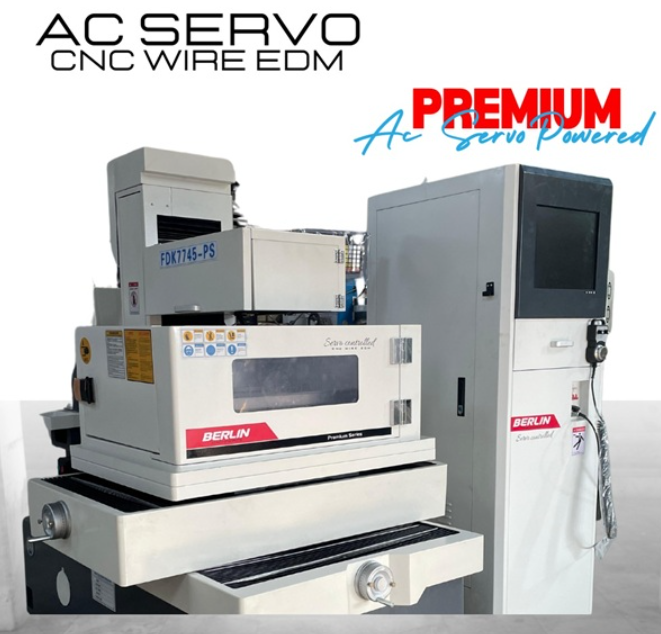
Not all machines deliver the same results. Machine rigidity plays a key role in maintaining accuracy during long cutting cycles. Precise servo control ensures smooth wire movement and stable cutting conditions.
Multi-cut capability improves surface finish and dimensional accuracy. Efficient flushing systems help remove debris and prevent wire breakage.
Industrial-grade CNC Wire Cut EDM machines are designed to handle these demands reliably, making them suitable for both tool rooms and production environments.
Conclusion: Is Wire Cut EDM the Right Metal Cutting Process for You?
Wire cut EDM offers a reliable solution when conventional metal cutting methods fall short. It delivers precision, repeatability, and material stability that modern manufacturing requires.
While it may not be the fastest process, its ability to machine hardened and complex parts with confidence makes it indispensable in many applications. Choosing the right process—and the right machine partner—ensures long-term success in precision metal cutting.
FAQs: Wire Cut EDM Process for Metal Cutting
Why is wire cut EDM preferred for precision metal cutting?
Wire cut EDM is preferred because it delivers high accuracy without applying cutting force. This makes it ideal for tight tolerances, complex profiles, and parts where dimensional stability is critical.
Can wire cut EDM machine fully hardened metals?
Yes. Wire cut EDM can machine fully hardened and heat-treated metals such as H13, D2, Cr12, and carbide without tool wear, distortion, or loss of hardness.
Is wire cut EDM more accurate than CNC milling?
For complex shapes, sharp internal corners, and high-tolerance parts, wire cut EDM offers better consistency and accuracy than CNC milling, especially on hardened materials.
Does wire cut EDM affect the material properties?
No. Since wire cut EDM is a non-contact process, it does not introduce mechanical stress. With proper settings and finishing cuts, material properties remain stable.
What industries benefit most from wire cut EDM?
Tool & die manufacturing, automotive, aerospace, medical, electronics, and precision engineering industries benefit most due to their need for accuracy and repeatability.
When should wire cut EDM be chosen over conventional machining?
Wire cut EDM should be chosen when parts are hardened, geometrically complex, sensitive to distortion, or when conventional machining results in tool breakage and repeated rework.
