

How Wire EDM Cuts Hardened Steel: Limits, Accuracy & Applications
Introduction: Why Cutting Hardened Steel Is a Challenge
If you have ever tried machining hardened steel, you already know how frustrating it can be. Once steel is heat-treated, traditional cutting methods begin to struggle. Tools wear out quickly, cutting accuracy drops, and even a small mistake can lead to distortion or scrap. Materials like H13, D2, Cr12, EN31, and carbide are especially difficult to machine after hardening, yet many precision components demand exactly that. This is where many manufacturers start searching for alternatives. The primary keyword wire EDM cutting hardened steel often comes up during this search, because Wire EDM offers a way to machine hard materials without physical cutting forces. Instead of fighting hardness, Wire EDM works around it. In this article, we explain how Wire EDM cuts hardened steel, where its limits lie, how accurate it really is, and where it is best used in real manufacturing environments.Can Wire EDM Cut Hardened Steel?
Yes, Wire EDM can cut fully hardened steel, even after heat treatment. The reason is simple. Wire EDM does not cut by force. It removes material using controlled electrical discharges. Because there is no direct contact between the cutting wire and the workpiece, hardness does not slow the process or damage cutting tools. As long as the material is electrically conductive, Wire EDM can machine it accurately, whether it is soft or fully hardened. This is why Wire EDM is widely used in tool rooms and precision manufacturing where parts are often heat-treated before final machining.How Wire EDM Cuts Hardened Steel (Simply Explained)
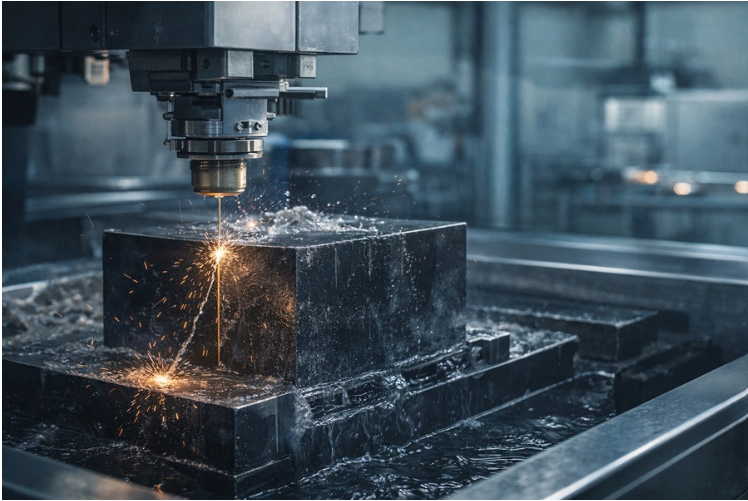
Think of Wire EDM as a “controlled lightning bolt.”- The Spark: The machine passes a high-voltage electrical current through a thin brass or molybdenum wire.
- The Erosion: When the wire gets close to the metal (without touching it), a spark jumps across the gap. This spark is so hot that it melts and vaporizes a tiny microscopic bit of the steel.
- The Cooling: The whole process happens inside a tank of “dielectric” fluid (specially filtered water). This water washes away the melted metal bits and keeps the part cool.
- The Path: A computer controls the wire, moving it along a digital path to create the shape you need.
Types of Hardened Steel Suited for Wire EDM
If it conducts electricity, a CNC wire cut EDM machine can handle it. Common materials seen in tool rooms include:- H13 Tool Steel: Used for hot-work applications like die casting.
- D2 / Cr12: High-carbon, high-chromium steels used for stamping dies.
- Carbide: Extremely brittle and hard; nearly impossible to machine traditionally but a perfect candidate for EDM.
- Exotic Alloys: Materials like Titanium or Inconel used in aerospace.
Choosing the Right Wire EDM Machine for Hardened Steel
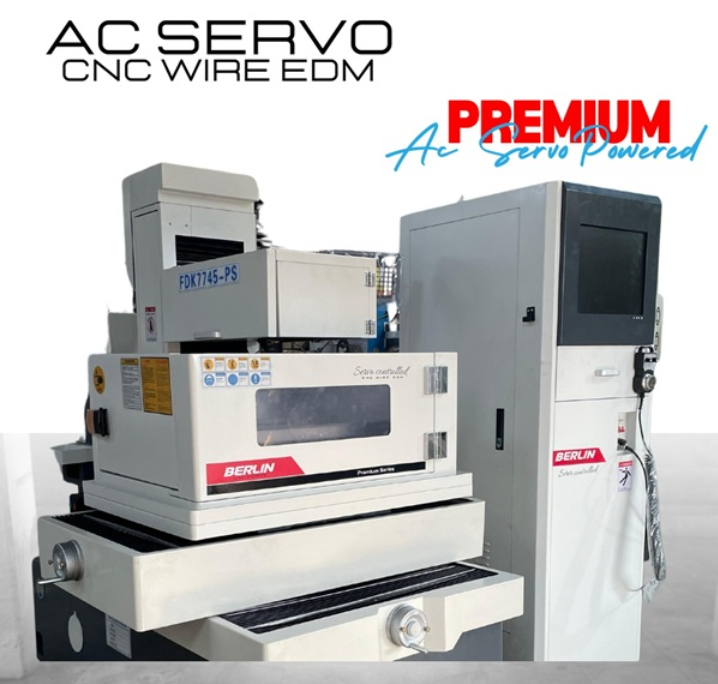 For hardened steel applications, machine quality makes a real difference. A rigid machine structure, precise servo control, and reliable multi-cut capability are essential to maintain accuracy and surface finish on heat-treated materials.
Factors like correct wire diameter selection and efficient flushing also play a key role in stable, consistent cutting.
Industrial-grade solutions such as the CNC Wire Cut EDM Machine – Premium Servo Series from Berlin Machineries are designed specifically for these demands. Built for precision tool rooms and production environments, this series delivers stable performance, fine surface finishes, and repeatable accuracy when cutting hardened steels.
Choosing the right machine not only improves part quality but also ensures long-term reliability and confidence in demanding machining applications.
For hardened steel applications, machine quality makes a real difference. A rigid machine structure, precise servo control, and reliable multi-cut capability are essential to maintain accuracy and surface finish on heat-treated materials.
Factors like correct wire diameter selection and efficient flushing also play a key role in stable, consistent cutting.
Industrial-grade solutions such as the CNC Wire Cut EDM Machine – Premium Servo Series from Berlin Machineries are designed specifically for these demands. Built for precision tool rooms and production environments, this series delivers stable performance, fine surface finishes, and repeatable accuracy when cutting hardened steels.
Choosing the right machine not only improves part quality but also ensures long-term reliability and confidence in demanding machining applications.
